
THE DYKES are expecting me. They are arranged in a loose circle on a grassy hill, a dozen or so elderly white lesbians perched on decrepit lawn chairs and frayed blankets. One woman is shirtless, and I try not to stare at her breasts, slung low against her milky stomach.
“There you are!” Bethroot cries, as if I’ve just slipped out of the forest. She wraps me in a long hug. “Welcome to the Equinox.” At eighty-one, Bethroot is a tiny but spritely dyke, dressed in an oversized corduroy jacket and loose linen pants patched at the knees. She invited me to the fall Equinox celebration a few weeks ago, and so I drove up to Southern Oregon from the Bay Area early that morning, bleary-eyed with a thermos of coffee, winding up the I-5 for seven cursed hours, passing swathes of burnt mountainsides, riverbeds reduced to creeks, creeks to grassy meadows, religious billboards promising salvation and hellfire that seems to have already descended on the scorched landscape.
I sit in a chair next to a short butch woman. A geriatric German Shepherd pants heavily beside her. “You must be the writer,” she says. The dog sneezes. “We’ve heard so much about you.” And I’ve read so much about you, I want to reply, but I just smile. I am a guest, and I need to tread carefully. These women are protective of their community, especially with writers, and for good reason: they’ve been burned before.
I’m at Fly Away Home, a 40-acre plot of land tucked onto the rocky slope of a mountainside. The property is part of a larger constellation of lesbian separatist collectives in the 100-mile stretch of land between Grants Pass and Roseburg in Southern Oregon, a region the landdykes like to call “Amazon Country” for the hills that resemble breasts. It’s a fitting name for the once-thriving mecca of women’s lands, the gay chapter of the back-to-the land movement of the 1970s where lesbian women (who henceforth referred to themselves as “landdykes”) created intentional communities that outlawed men from living amongst them.
As more women arrive, someone jokes, “We’re here, we’re queer!”
“If you even call yourself that,” the shirtless woman says. “I’m a lesbian.” The exchange underscores a larger linguistic tension, the double-bind of taxonomy: if you are one thing, you are not another. Identity is a razor’s edge.
But there’s no room for arguments now; it’s time to sing. The dykes sing songs of goddesses, sisterhood, the divine feminine. My voice is shaky, but I try to harmonize as best I can.
Revolution starts in the circle, rising up from the ground / We believe in the power of women to turn this world around.
It’s been a long time since I’ve sung among strangers, and the sensation brings me back to the Catholic hymns of my childhood, all those hours spent kneeling and sitting and chanting, watching light cleave through stained glass. For a moment, I almost miss it. The opportunities to submit myself to higher meanings feel rarer and rarer these days.
Overhead, a trio of turkey vultures glide in dizzying circles. A woman throws her head to the sky, calling out the name of her recently deceased sister. I drop my eyes from the birds and look around the circle at the women, the last of their generation. Since the mid-1970s, the landdykes have gathered at Fly Away Home to celebrate the fall Equinox, the day the sun crosses the equator, splitting day and night into equal parts. Unfortunately, life off the grid—in many cases, without internet, cell phone service or indoor plumbing—is less appealing than it used to be, and these days there’s only a handful of elderly women left, waiting for the arrival of the next generation of women to inherit the world they worked so hard to create. Even if they’re wary of ethnographic interlopers like myself, I’m also seen as a potential harbinger of the future: the prodigal dyke on the horizon. Indeed, my presence at the Equinox sends out a ripple of excitement among the landdykes—why else would I have come all this way?
In between songs, the butch woman turns to me and asks outright if I am interested in “this type of life.” She looks so hopeful; I choose my words deliberately. “I don’t know yet,” I say.
It’s true that I’ve been dreaming of hills like these myself. As my friends and I settle into our late twenties and early thirties, we’ve started to daydream aloud of leaving the city to settle a plot of land with a community of like-minded people, just as these women did. There are visions of farming the land, weekends spent preserving and pickling vegetables, raising children who run barefoot through the forest, coming home only at dinnertime. The isolation of the pandemic—and the claustrophobia of staying indoors in a crowded city, compounded by an economic recession and climate disaster—has only sweetened the bucolic dream.
But I hesitate to share this with the butch woman, lest I seed false hope. Being on women’s land feels like stepping into a strange universe that might vanish at any moment. I can’t say what exactly I’m hoping to find here, only that I feel an inexplicable impulse to linger and see what happens next.
I FIRST learned of the women’s lands in my mid-twenties. I was living with a group of queer women in Berkeley in an old craftsman house with cracked walls and chipped molding. At the time, my roommate Kara and I were the only single tenants. We tried not to be too miserable about it.
One night in the fall of 2018, as we stood in the kitchen eating Trader Joe’s dumplings straight from the microwave, musing on where we might move next, Kara mentioned that a lot of lesbians live in Southern Oregon. “There are like, whole communities of them in small towns.”

“Like communes?” I was skeptical. I’d attended the University of Oregon and lived in Eugene for years and never heard of anything like it.
She shrugged. “Maybe.”
I was intrigued. Growing up Catholic in suburban Cincinnati, I had known approximately zero queer people. In my Catholic grade school, queerness existed only as a joke, a barb: kids on the bus yelling, “That’s so gay!,” the word dyke whispered as soon as the teacher’s broad back was turned, felt-tipped graffiti scrawled on a bathroom stall. In middle school, a rumor went around that if your index finger was shorter than your ring finger, it meant you were a lesbian. When I looked down at my own hands, I noted with relief that my body did not mark me as different, not yet. Lesbian. A sibilant hiss, the term barely registered back then, even though I had no interest in boys. In the years that followed, I rode a spiritual restlessness. I couldn’t wait to get out of the suburbs, out of the Midwest, out of Catholicism. I wanted to move out West, to a place where people lived and spoke of sophisticated things, like sex and politics, with such frankness you’d never guess that they’d ever experienced anything close to the ennui of a strip mall. Back then, it seemed like my life, my real life, was happening elsewhere, and I was trapped just outside its door.
I hoped to find a truer version of myself out West, just as the landdykes believed they could build a dyke paradise in Southern Oregon. This “manifest destiny” framework is deeply rooted in the American psyche, the ever-optimistic possibility of a better life in the New World. But if America was initially conceived as a utopian project, it was—and continues to be—borne out by the failures of that project.
During the 1970s, these societal failures were hard to ignore. The radical hope that had powered massive social movements in the previous decade—the civil rights movement, migrant farmer strikes, the counterculture’s “summer of love”—could not prevail over the fallout from the Vietnam War, a failing economy, and the ever-present threat of nuclear apocalypse. Nihilism lingered in the air, staved off momentarily by disco and dance clubs, polyester suits and dubious self-help books. Many people yearned for a simpler life, unburdened by the costs of consumerism and environmental degradation. As civic faith dwindled, the notion of leading an autonomous life off the grid grew in popularity, and the back-to-the-land movement took root in rural areas across the country. On the West Coast, Oregon became a hotspot for these experimental communities. Land was cheap, water sources were plentiful, and the wilderness created a sense of anonymity, a privacy that urban centers lacked. The experimental communities varied, ranging from large hippie communes to single family homesteads to lesbians on women’s land like Fly Away Home, which was founded in 1976.
While the ‘70s were a tumultuous era for Americans writ-large, the decade also included significant triumphs for the women’s liberation movement. A succession of Supreme Court decisions made birth control—most notably, abortion—legal for women, unmarried or not. In one of the most famous tennis matches of all time, Billie Jean King ran circles around trash-talking Bobby Riggs. Women let out a nationwide sigh of relief with the publication of Anne Koedt’s seminal essay, “The myth of the vaginal orgasm.” Things were looking up.
But mainstream second-wave feminism inspired a mainstream audience: cisgender, straight, upper-middle class white women. Women of color, trans women, queer women, and poor women were largely ignored. Embedded in liberatory texts like Betty Freidan’s The Feminine Mystique is what Adrienne Rich called “compulsory heterosexuality,” an organization of women’s lives, even their political liberation, around men. “The possibility of a woman who does not exist sexually for men—the lesbian possibility—is buried, erased, occluded, distorted, misnamed, and driven underground,” Rich wrote. As president of the newly formed National Organization for Women, Freidan referred to lesbians as a “lavender menace,” a threat in the quest for women’s rights. Such acrimonious discrimination incited lesbians nationwide to start politically organizing for their own set of legislative priorities, and in the case of the landdykes, to start imagining whole communities designed solely for lesbians.
It’s not surprising that the exclusion from heterosexist feminism struck a deep and painful chord with lesbian and queer women. Straight women like Freidan didn’t have to worry about losing their family, or being thrown into a psych ward, or fired from their jobs, or denied a line of credit, or violently attacked, all because “homosexuality” was considered deviant and, in certain states, illegal. “Not much was known about lesbians, and if it was known, it was a Well of Loneliness type of thing,” said landdyke Jemma Crae, referring to the novel’s themes of internalized homophobia and self-hatred. Jemma is the founder of the women’s land Steppingwoods, where I visited in the summer of 2021. In the late 1950s, when she was 18 years old, Jemma fell in love with a woman who identified as a lesbian. “A light bulb went off in my head. Oh, so that’s what I am!” Jemma said. “I was really happy that I had a word for it. I had something to recognize.” The recognition only deepened when Jemma stumbled upon the communities of women’s lands.
I knew the feeling. During my early years at the University of Oregon, I’d bike through the dark wet to house parties where I sat on filthy couches, watching women enter and exit the room with enviable ease, the proximity and heat of their bodies almost painful, wondering about the calculus of queerness, whether I was or wasn’t. Like Jemma, I was elated and relieved when I finally came out. There’s something comforting about slipping into a word, organizing your life around an identity.

SOUTHERN OREGON is an unlikely—if not unthinkable—candidate for lesbian separatism. Hemmed in by the Umpqua River to the north and the Rogue River to the south, the region is touted for its fertile soil, scenic vistas, and madrone-ridden mountains. It is also very poor and very white. The glory days are behind these timber towns, Roseburg and Grants Pass and Medford, where lumber mills once buzzed with middle-class dreams of steady employment and an affordable mortgage. Alas: the mills are now shuttered, the hillsides blackened by fire, scalped by loggers. Like most regions struggling with decades of economic depression, a general distrust of the government lingers. Drive along any backroad for 15 minutes and you’ll spot flags for secessionist movements like State of Jefferson. Out in the shadowed valleys of the Klamath Mountains, isolationism is a way of life. It’s a good place to go if you want—or need—to disappear.
By the mid-1970s, groups of lesbians had established homesteads along in the area, forming a rhizomatic landdyke community: Fly Away Home, WomanShare, Rainbow’s End, Gypsy Cafe, Steppingwoods, OWL Farm. The governing structure of each land differed—some were large compounds, others were privately owned land open to female travelers, a few were under the umbrella of a land trust—but the central conceit remained the same: no men could live on the land. In some cases, men couldn’t even visit the land, not even sons. Upon witnessing my surprise at this rule, some of the lesbians I’ve interviewed bristled. “It wasn’t about hating men,” Carol Newhouse, one of the founders of WomanShare in Wolf Creek, told me, somewhat impatiently. “It was about getting away from them.”

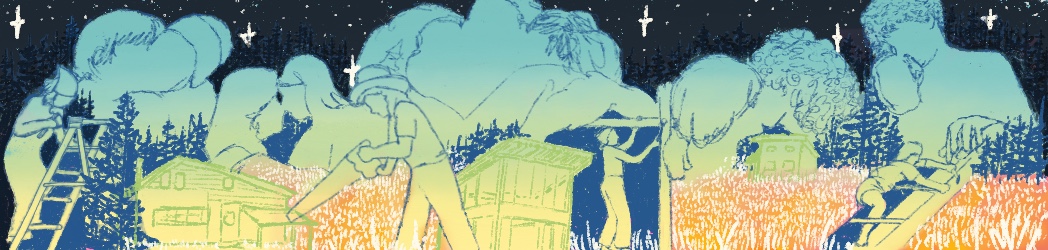
Living on women’s land was an experiment in building paradise. The landdykes terraced mountain hillsides into gardens. They pooled unemployment and food stamps. They built yurts, cabins, and houses by hand. They shat in 5-gallon buckets and pissed wherever they liked. In the winter, they stoked fires in wood stoves to keep warm; in the summer, they roamed naked, eating berries by the handful and making love under the moonlight. They ditched God for Gaia, celebrated the solstices and equinoxes with sacred rituals. They removed men not only from their lives but from their vocabulary: “women” became “womyn,” “seminars” became “ovulars,” “menstruation” into “moonstration.” They shed their birth names and adopted new ones: Bethroot, Madrone, Shewolf, Morningstar, Moon. They seized a new beginning, the once-in-a-lifetime opportunity to slip out of their old lives and start anew. On women’s land, you could be anyone. “We are feminists working and living together to encourage and help one another to create a life where we are free of all oppression,” an early manifesto for OWL Farm reads. Hopes soared for the restorative power of women’s lands. “Everybody was good at carpentry or welding or car engines or building a structure or chopping wood or felling trees,” former landdyke Aggie Agapito said in an interview with the Eugene Lesbian History Project. “There was nothing we couldn’t do.”
Not everyone was moved by this brave new world. Lesbians of color were not particularly inspired to live among starry-eyed white women in the boonies. In 1977, the Black lesbian Combahee River Collective rejected the idea of lesbian separatism because “it leaves out far too much and too many people, particularly Black men, women, and children.” For all its revolutionary overtures, lesbian feminism wasn’t immune from replicating the same oppressive structures it spurned. Declaring sexual oppression as the zeitgeist of identity overshadowed the very present and dangerous impacts of racism and classism, allowing whiteness as a marker of identity to go largely unnamed in the movement. Lesbian separatism was dreamt of and enacted by white women; women of color (or “third world sisters,” as they called themselves) who lived on the lands in Southern Oregon were brief tenants, largely due to microaggressions within the white dyke community and the more overt racism in sundown towns like Roseburg and Grants Pass. Then as now, the landdykes grappled with the shortcomings of their utopian project. “We do not want to see a village of only white middle-class wimmin,” read the 1976 notes from an Oregon Women’s Land Trust meeting. “We keep struggling together and looking inside ourselves to work at breaking the conditioning that we oppress each other with.” But the deeper problem was structural: identifying as a lesbian woman was not an immediate catalyst for solidarity.
“We do not want to see a village of only white middle-class wimmin. We keep struggling together and looking inside ourselves to work at breaking the conditioning that we oppress each other with.”
notes from an Oregon Women’s Land Trust meeting, 1976
But what’s in a name, anyhow? Not even self-proclaimed lesbians could agree on the term itself: “lesbian.” For many women, identifying politically as a lesbian didn’t necessarily indicate a sexual preference but rather a commitment to the ideals of a women-centric world where men (and sex) need not be part of the equation. Even the language of lesbian identity construction was ungovernable, what critic Andrea Long Chu calls a “tapestry of qualifiers”: women identified as lesbians, dykes, landdykes, sapphics, queers. The term “dyke” was particularly primed for a linguistic reclamation, as women twisted a harsh insult into a badge of honor, a rebellion against heteronormativity.
“Lesbianism is the antidote to misogyny,” Bethroot liked to remind me. Her coming-out story was not the archetypal lesbian saga, a tragedy built on the self-loathing force of hidden desire or a “Well of Loneliness type of thing.” In many ways, it was much simpler than that. “My lesbianism came into practice inside of the container of feminist activism and women’s liberation activism,” Bethroot said. In 1968, while working for the YWCA, Bethroot attended the National Women’s Liberation Conference, where she connected with a network of New Left organizers, academics, and dykes, lots of dykes. For Bethroot, then in her mid-20s, this was the first time lesbianism seemed like an option, a divine path into the counterrevolution of feminism that would later become her life’s work. “That was the air I breathed,” she said. And voila! A new dyke was born.
While there was no exact formula to being a “legitimate” lesbian on women’s lands, there was one general prerequisite: being born with a vagina. In the radical lesbian movement, trans women seemed to pose a problem of legibility: what were the bounds of womanhood, and who determined it? Many lands refused to allow trans women to live there, citing the immutability of womanhood. On the other hand, if a landdyke transitioned to being a man—as several eventually did—then the dykes had to decide whether or not he could stay on the land, as he was no longer lesbian nor woman. Taking pride in womanhood was a critical tenet of radical lesbianism, often rendering gender identities that existed outside the male-female binary threatening.

The women’s lands that still exist today are divided on how to understand gender in this contemporary queer age, with some lesbians opting to accept transgender, genderqueer, and nonbinary people on the land and others rejecting them. For instance, Huntington Open Women’s Land (HOWL) in Vermont is open to “the full diversity of women, regardless of gender assigned at birth,” according to their website. As for lands that allow only cisgender women, these policies are often unwritten and generally harder to pin down, in part because these communities don’t wish to be derided as TERFs, or “trans-exclusive radical feminists,” for fear of backlash from the queer community. In one of my introductory phone calls to a Southern Oregon women’s land, a landdyke (who asked to be unnamed due to privacy) asked if I was a “natal born” female. When I answered that I was, she seemed relieved. “Okay good,” she said. “That’s important to us.” When I pressed her on the issue, she explained that her land was envisioned specifically for women-born women, and while she supported transgender people creating their own communities, she wasn’t keen on letting them join hers.
The schism over gender identity points to the larger generational differences between the landdykes—who proudly declared their lesbianism in the face of bigotry and overt oppression—and contemporary queer culture, which eschews labels in favor of fluidity and whose members arguably enjoy more human rights than their predecessors. But the radical lesbians’ grievances with exclusion from second-wave feminism belies the reality that many of them actively exclude trans people, proving that experiencing oppression is hardly an antidote to enacting it.
The paradigms of American queer culture have shifted, blurring categories or refusing them altogether. A 2021 poll by The Trevor Project found that 25% of LGBTQ+ youth identify as non-binary, sharing your pronouns in conversation is as commonplace as reflecting on the weather, and the queer lexicon continues to evolve at a breakneck speed: omnigender, allosexism, monosexual. In a certain light, this evolution is a beautiful thing to witness; in another, it can be utterly incomprehensible.
FEW UTOPIAN dreams escape the banalities of bureaucracy; the women’s lands were no exception. In an attempt to dismantle hierarchical power structures, the landdykes used consensus decision-making, a choice that resulted in marathon meetings where important questions—how to structure rent, how to tend the land—played out in equal measure with petty arguments, like what to grow in the garden, whether to have dogs on the land, how to regulate toilet paper use. When Reagan-era economics decimated the welfare system (the critical financial source for these “armchair socialist” lesbians), money became perpetually tight, causing tensions over class privilege, namely who had inherited wealth and who had not, who held a job and who didn’t. While living off the land was blissful in the summer, it was miserable in the winter. Years of shitting in a bucket and pissing outside, fending off bears from the garden, and scrambling to find reliable work took their toll. For many women, the siren song of separatism finally lost its sheen.
Although Southern Oregon was home to numerous women’s lands and a few faerie lands (where gay men lived), the region was more hostile to gay and lesbian communities than its neighbors up Interstate-5, Eugene and Portland. The landdykes worked to remain on good terms with their neighbors and to be “discreet” when they went into town. Jemma recalls feeling nervous about moving to Southern Oregon. “I had some roommates in college that were from Roseburg, and they were telling me about the sundown laws and all that kind of thing. And I thought, Oh, gee, it’s pretty conservative down here. Do I really want to be there?”
In a letter to dykes who visit women’s lands, one woman pleads for visitors to “save all those subversive City dyke actions—like graffiti writing, radical-dyke exclamation and confrontation, stealing merchandise, Queer nation kiss-ins, etc.—save them for the city! These country dykes have to live with the consequences of your behavior.” Code-switching was a prerequisite for survival, and despite all the research I’d done before visiting the women’s lands, I still couldn’t fully comprehend this. During one of my early visits to the lands, I volunteered to help an elderly lesbian named Hawk lay down over 200 feet of PVC pipe through the property to connect to the municipal water line. As I crouched on the dry forest floor, in desperate need of small talk as I fumbled to fit the pipe into metal clasps, I asked if she was dating anyone. She stared at me for a moment, then barked out a laugh. “No,” she said. “I’m not dating anyone. We didn’t date back then. You were just with someone.” The concept floored me. How many nights had I spent killing time browsing a dating app while sitting on my couch, swiping haphazardly on pixelated photographs of women climbing mountains or hugging dogs, trusting that the algorithm would always churn out another possibility?
Even now, the landdykes retain an edge of privacy about their lesbianism. “When I go to Roseburg and I go to the stores, it’s rare that I look around and feel reflected as a lesbian,” Bethroot admitted to me. “Whereas in Portland, when I go to the store, I see women that look to me like they’re lesbians.” Even with the ushering in of Pride parades and the growth of queer community organizations like the Rainbow Collective, there’s ample reason to remain cautious in Amazon Country: just this past summer, a constellation of homeless shelters affiliated with the faith-based organization Rogue Retreat were accused of subjecting gay residents to conversion therapy. More than 40 years after women’s lands first began, lesbian liberation is still safest when confined to the dark hills.
TIME IS different on women’s land. Decades stretch and fold into each other: the trees grow higher, the women older, their gardens wilder. Years are measured by lovers and breakups, the bounty of harvests, the slow construction of yurts and cabins, children and grandchildren. There’s a term for such elasticity: “lesbian standard time.” But death is never far from a landdyke’s mind. Once during a walk on a woman’s land west of Roseburg, a dyke tapped my shoulder, pointing to a pile of wood stacked against a cabin. “See that cedar over there?” she said. “That’s for my coffin.” I laughed until I realized she was serious.
Planning for your own death is one thing, but planning for the future of women’s lands is another task entirely. During the heyday of the back-to-the-land movements, there were approximately eight collectives in Southern Oregon, and while a majority of them still exist in one form or another, they are mostly populated by older lesbians who face problems of accessibility and declining physical health. Most of the lands are located precariously in the wildland urban interface, and as climate change and extreme drought have eviscerated the American West over the past decade, many women have had to evacuate their homes to escape wildfire. Thus far, I’ve only discovered one Southern Oregon land that has successfully secured a transfer into younger hands: WomanShare, which is now Native WomanShare, a land for queer BIPOC and two-spirit people. While I have personal doubts about whether the women’s land community in Amazon Country will survive, a flurry of recent press coverage, academic scholarship, and artistic projects—combined with economic calamity, soaring housing prices nationwide, and the gloomy consensus that human life on this planet might be doomed—has spurred renewed interest in women’s land communities from younger lesbians and queer people across the nation.
I spoke to Ophelia and Ash, a queer millennial couple previously living in Philadelphia who were now traveling West in search of women’s lands to live on. Like me, they’d discovered women’s lands only recently and were similarly struck by the history. “I feel like my life has completely changed after discovering this facet of lesbian culture,” Ash told me. “My friends would always joke like, We’re gonna start a commune one of these days but none of us realized that it had already happened.” Ophelia added, “It’s kind of like this iterative cosmic soup. The idea is great, so people keep doing it.”
Bethroot once asked me what she could do to make Fly Away Home—and women’s lands generally—more appealing to my generation. We were sitting in her house, a decagonal structure with an open floor plan and two small lofts, waiting out the wildfire smoke from a nearby burn before returning to the garden. I looked around the room. Dishes and empty yogurt containers crowded the kitchen sink, the wreckage spilling onto the counter; notebooks and flyers covered the kitchen table; a makeshift altar for the dead took up residence by the doorway. Smoke dimmed the sunlight streaming in through the windows, through which I could see the “poo-goodah,” the wood shed toilet where just that morning I pooped into a 5-gallon bucket, ruining an intricate cobweb when I reached for a handful of sawdust.
“Wi-fi might be nice,” I said.
“WHY ARE you so obsessed with these lands?” my friends ask me. Once fascinated by the topic, they’ve grown weary of hearing me muse over it for the past few years. I’ve been asking myself the same question. Why do I keep returning to the dry hills of Southern Oregon? If I don’t wish to live on women’s lands, then what am I hoping to find among these geriatric lesbians?
The answer was so obvious it took me an inordinately long time to realize: the landdykes are the first lesbian elders I’ve ever met. Although I’ve been out of the closet for almost a decade now, I’ve never actually imagined what being old and gay might actually look like. Will I be partnered? Will I have five dogs? Will I be living in a shack in the woods? When I try to conjure an image, my mind sputters, then goes blank. Even armed with my millennial queer frameworks, my invocation of Butler and Foucault in casual conversation, there are unspoken parameters to my own imagination, limits to my subjunctives of who I can and cannot become.

During one of my visits to Southern Oregon, I witnessed an old dyke floating in a pond in a flamingo inner tube, a pool noodle draped across her knees, naked as a clove of peeled garlic. The image stuck with me: her flesh sagged from her arms like pizza dough, stretch marks lined her thighs, indigo bruises dotted her hips. I couldn’t look away. Her body was not conventionally beautiful, but perhaps that was the point. To exist outside of mainstream expectation is nothing short of radical, and I suspect this is what I’ve been searching for in those hills, the affirmation that people like me have always found ways to survive with joy and connection, even without an obvious precedent.
Although legislative and cultural progress has certainly been made in America—gay marriage is legal (for now), antidiscrimination laws protect employment, The L Word franchise is still going strong—something is lost, I think, in the modern milieu of queerness. I’m reminded of the question Maggie Nelson posed in “The Argonauts”: “How to explain, in a culture frantic for resolution, that sometimes the shit stays messy?” In modern feminist discourse, lesbian separatism is often seen as an anachronistic embarrassment, a political disappointment, a chapter that must not be repeated because it reflects poorly on “us.” The various critiques of lesbian separatism are valid—the lack of intersectionality, the latent transphobia, the particularities of white naivety, the colonial mindset of conquering the world anew—but then again, a cohesive vision of lesbianism has never existed, and to protest otherwise is to flatten a diverse identity into a monolith.
Besides, moralizing queerness to convince a straight audience of your humanity is a Sisyphean task. In an era when it’s never been more acceptable to identify as something other than 100% straight in America, danger still abounds: deadly shootings in gay nightclubs, a squall of anti-trans bills, the warping of history to suit a straight, white audience. “Things have come such a long way, though!” is a common refrain, but it’s hard to be optimistic when progress hinges on straight people begrudgingly acknowledging your humanity. While modern life is certainly more amenable to queer people than it was for the landdykes back in the ‘70s, I can still understand the impulse to pack your bags and head for the hills, although it’s dubious whether such a decision ever dismantles the oppressive machinery that spurs it. Even so, it’s no small act of courage—or hope—to leave the world that never existed with you in mind and fashion one that did.
It’s easy to write off women’s lands as an artifact of the past, and the dykes are particularly sensitive on the subject. “We’re still here,” more than one lesbian has told me. “We still exist!” Despite the toll of time, women’s land communities persist, and they’re trying to adapt. The landdykes are afraid of being forgotten, and with good reason: most people don’t even know they exist in the first place. Your own obsolescence is a bitter pill to swallow, but the landdykes hold out hope for the next generation to continue their legacy. They are waiting for the prodigal daughters to arrive. I’m reminded of a dinner I once had with Jemma, the Steppingwoods founder who is now pushing 80 years old, when I asked if she was excited for new women to live on the land after her death. We were sitting around a small table in her kitchen; the evening news played softly from the television in the next room.
“Of course,” she said, twirling spaghetti around her fork. Then she sighed and looked right at me. “But will they come?”
This story was made possible by the support of Sunday Long Read subscribers and publishing partner Ruth Ann Harnisch. Illustrated by Bailey Zahniser. Edited by Kiley Bense. Designed by Anagha Srikanth.

Bethany Kaylor
Bethany Kaylor (she/her) is a writer and illustrator living in Berkeley, Calif. Her essays and short fiction can be found on Salon, Mid-American Review, Sonora Review, Literary Hub, DIAGRAM, and elsewhere. She was the winner of the Sherwood Anderson Fiction Award Prize in 2020 and a recipient of the Barbara Deming Memorial Fund grant in 2023. When she’s not writing about niche subcultures, she’s walking her dog, playing mediocre pick-up basketball, or cooking beans.
Leave a Reply
You must be logged in to post a comment.