
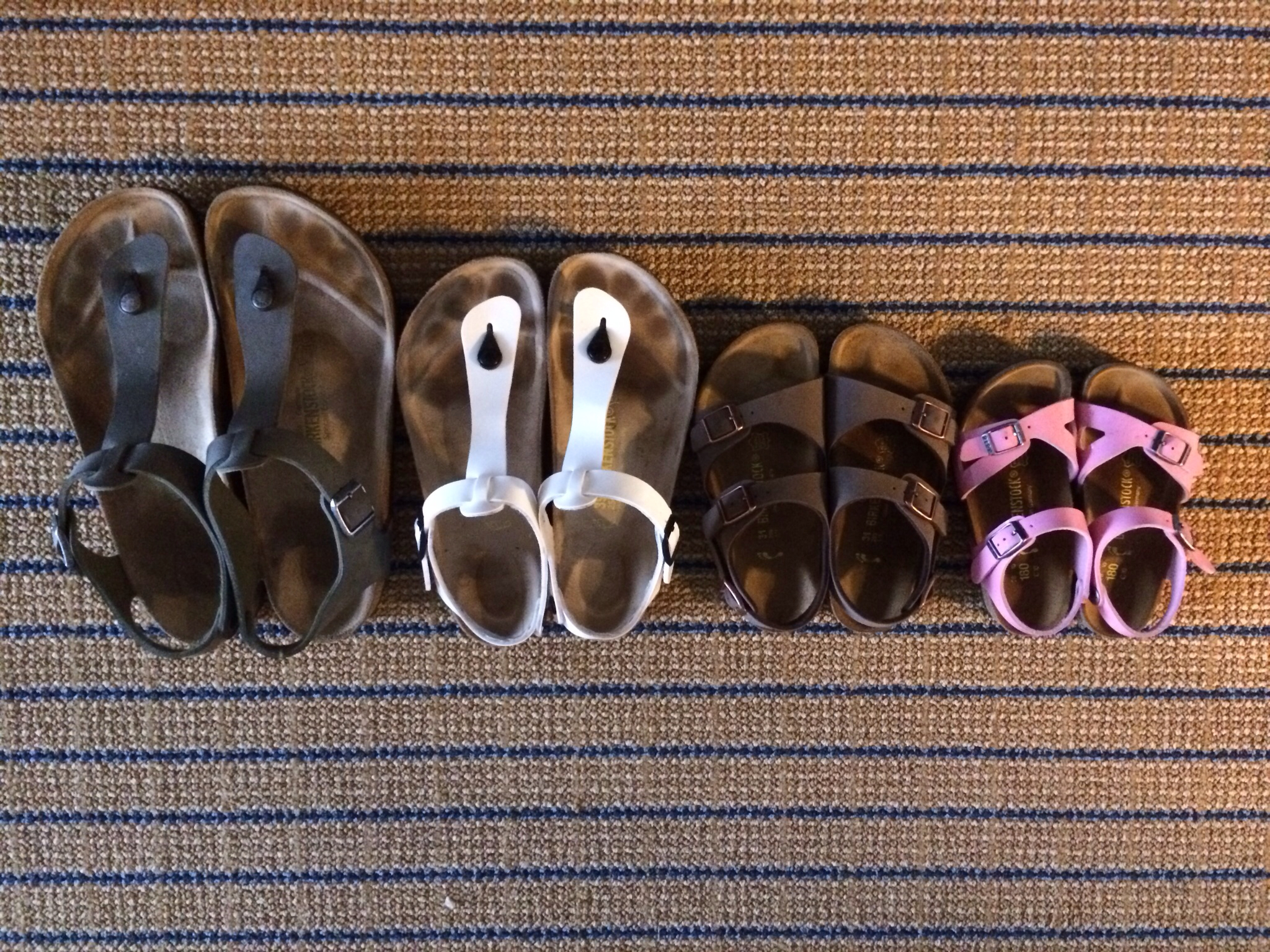
One of the main selling points of Birkenstock sandals — the world-famous “ugly shoe” worn by both Steve Jobs and Barbie — is its purported benefit to foot health.

When the German company went public last year, its larger-than-life CEO described the shoe’s patented “footbed” as promoting Naturgewolltes Gehen, which generally means walking the way nature intended.
“I think that’s sort of the beating heart of the company,” Bloomberg journalist Tim Loh told The Sunday Long Read. “With that orthopedic backdrop, it really is something that sets them apart, above all because they really believe it. And I talked to some podiatrists and whatnot who agree that, yeah, these are very good footwear.”
But that emphasis on health doesn’t mean Birkenstock hasn’t had its fair share of ups and downs over the course of its lengthy corporate history.
In a recent feature for Bloomberg, Loh sketched the company’s growth over the centuries: starting officially with Carl Birkenstock in the early 1900s, leading to a period of “Succession-level family drama,” and culminating in the emergence of a “luxury behemoth.”

Join us today, either as a free subscriber or a paying member. Just click here!
Loh, who is based in Munich, said he was looking for his next big story last summer when Birkenstock suddenly appeared on his radar. Birkenstocks had just been featured in the “Barbie” movie, plus Loh was getting some scoops about the company’s IPO plans.
“I didn’t know a lot about the backstory of the company at that time,” he said. “It was just like a treasure trove; the more I read, it was getting richer and richer, and I start getting more and more excited and kept rolling with it.”
The following interview has been lightly edited for brevity and clarity.
Can you talk about why this idea of Birkenstocks actually being good for your feet is one of the lasting appeals of this company, despite its other corporate peaks and valleys?
This belief and sense of purpose that is clearly emanating from the company — I think over the years, and even generations, that’s been like a North Star for them. And when it comes to kind of playing around with that, which they’ve done a lot in recent years with these collaborations and spicing it up a bit, they’re super committed to this “footbed” as something that really cannot be messed with.
And clearly that mission stems from the origin of the company, right, when customers had to take a class on the benefits of the insoles before they could actually buy the product?
Exactly. That was Carl with a C. He was kind of running the show in the ’20s, ’30s, ’40s and ’50s. He had inherited [the idea of the insoles] from his father Konrad, who himself was a fourth-generation Birkenstock cobbler. Around the turn of the century, Konrad was the one who came up with a couple of innovations and patented this “footbed.” They were struggling to try to convince the German shoe world to embrace what they thought were clearly superior products and innovations. Carl put on these week-long seminars, and for a while was only selling to people who had taken his own course, because he didn’t think that the masses could quite appreciate how great they were. Then his son, Karl with a K, is the guy who basically invented the sandals that we all know and either love or hate — or hate-love. He invented them in the ’60s. He was the one who sort of cracked the code, and took this “footbed” technology that his father and his grandfather had never been able to figure out how to turn into a shoe or product that could scale and work as a business.
So essentially what the company says is that the best thing for the human foot is to walk barefoot in, basically, pristine nature. And the surface should be yielding and uneven, and it should support your arches and other parts of your foot, but not too much. Then they say that in today’s world we have hard floors and we have cement. And this is very bad for your foot, and doesn’t support the arches and doesn’t allow your foot to properly walk, in the way that they call in German phrasing Naturgewolltes Gehen, which is walking the way that nature intended. They argue that their “footbed” is the second-best option to that. So if you can’t walk barefoot for your whole life out in nature, then you should get yourself a pair of Birkenstock sandals, they say, because this is the second-best way.
You also write about the fact that Carl with a C was a member of the Nazi Party at one point, and was trying to convince Nazi soldiers to wear the insoles. Why do you think that piece of corporate history hasn’t come back to bite them in a significant way?
That is obviously a very sensitive time in German history; pretty much every company that existed through that period has a history there, one way or the other. At the time, Birkenstock was quite small as a company, you know, we’re talking 10 workers perhaps. While Carl with a C did try to get contracts with the Nazi regime, he never succeeded at that. Hugo Boss for example, another company that is sort of in the same space, had much bigger ties. Adidas [and Puma] had a history with the Nazi regime.
It is true that Carl joined the Nazi Party pretty late, in 1940. Birkenstock put together this big company history that they’re coming out with right now, which is their 250th anniversary. They’re sort of working through some of this history publicly for the first time, which is something that a lot of German companies have done, and a lot have already done. There may be more conversation about that coming. But I think it’s important to keep in mind that they were very small, and they didn’t have any contracts. That said, Carl with a C — and the company is upfront about this in their new history book — repeatedly did try to get contracts, because that would have been helpful for him to gain wider adoption of his family’s “footbed” ideology.
For this story, you interviewed the company’s CEO, who is not a member of the Birkenstock family. Do you think the company could have survived without an outsider coming in?
It’s a good question. I mean, they had survived about 240 years up to that point. So I certainly wouldn’t go out on a limb and say that they wouldn’t be here today without him. That said, he’s been really remarkable in terms of what he’s done with the company. When he arrived with the company back in 2009 or so, Birkenstock was really this kind of weird, loose connection of corporate entities that were all interlinked with each other. And the ownership was parceled out among three brothers and their father, Karl with a K. It was madness. Oliver Reichert was brought in, and one of his first achievements was creating order out of all this and streamlining it into a unified company. I think in that process he distilled what, in his eyes, was the essence of Birkenstock and where it could go. Since then, I think he’s had a really focused, long-term approach to it. It’s been very successful. I gotta give the guy credit.
What do you think the takeaway is for other companies, particularly German family companies?
Germany’s famous for their mittelstand, which are mid-sized family businesses that have specialized in oftentimes quite obscure things, like the world’s best company for boring long tunnels — there’s a family business that does that, and they’re world-renowned. So these are unsexy things that it turns out everyone needs. For decades, this has been the backbone of the German economy.
In recent years, there’s been more and more of a discussion, and a lot of times now we’re getting several generations in with these families. Just like with Birkenstock, sometimes you have some sort of disagreement among the people that have a claim to ownership in a company, or the direction of it. In the private equity world, this is seen as very fertile ground to try to get in, to see if you can gain some sort of ownership in these companies, and bring in some people that have new ideas. That’s definitely playing out.
With some family-owned German companies, there’s increasingly an openness to bringing in some outsiders to try to inject some new views, and to take a fresh approach to some things. I do think that Birkenstock, in that sense, is an example that some of these family-owned companies may look to and say, “Wow, we have this rich heritage, we have this commitment to quality. And maybe if we sort of loosen up a little bit and bring in some fresh ideas at the top, we can turbo-charge growth.”
What are some of the disadvantages and advantages that you’ve had while reporting from Munich on some of these companies, compared to reporting stateside?
I’d say the obvious disadvantage, I suppose, is a company like Birkenstock is listed on the New York Stock Exchange. So there are tons of Wall Street analysts and investors that are based in New York. Back when I was in New York City, it was easy after work to go grab drinks with an investor or an analyst or whatever, and chat with them about some of these companies. Here, there’s a time difference. There’s a lot of critical mass of interesting people to talk to who are in New York.
That said, you can still have conversations over Zoom. And particularly if you’re covering European companies, being based here you have an interesting perspective that those people based in New York are excited to talk to you about. Like, “Whoa, what are people saying in Germany about this?” So there are upsides and downsides. I’ve gotten used to late-night emails with people in New York or California, and late-night phone calls sometimes, but it’s usually pretty manageable.
Sometimes back in New York, there’s just so much focus on New York that it can be challenging to carve out your own space. And here there’s a bit more oxygen in the air.
I guess the looming question is: Do you now own a pair of Birkenstocks?
I must acknowledge, as a good journalist, I did buy — with my own money — my first pair of Birkenstocks last fall, because I was so curious about this. I bought a pair of the “Milano,” which is like the “Arizona” so it’s open-toed but with a strap over the back heel, and I bought them in October, so it wasn’t the ideal time to buy them. I spent a lot of the winter just wearing them in our apartment building. But now it’s getting warm and I’ve been wearing them more and more. And I gotta say, I’m finding them pretty comfortable.
Compiled by Amanda Ulrich. Photos courtesy of Tim Loh and Jencu/Creative Commons via Flickr.
Leave a Reply
You must be logged in to post a comment.