
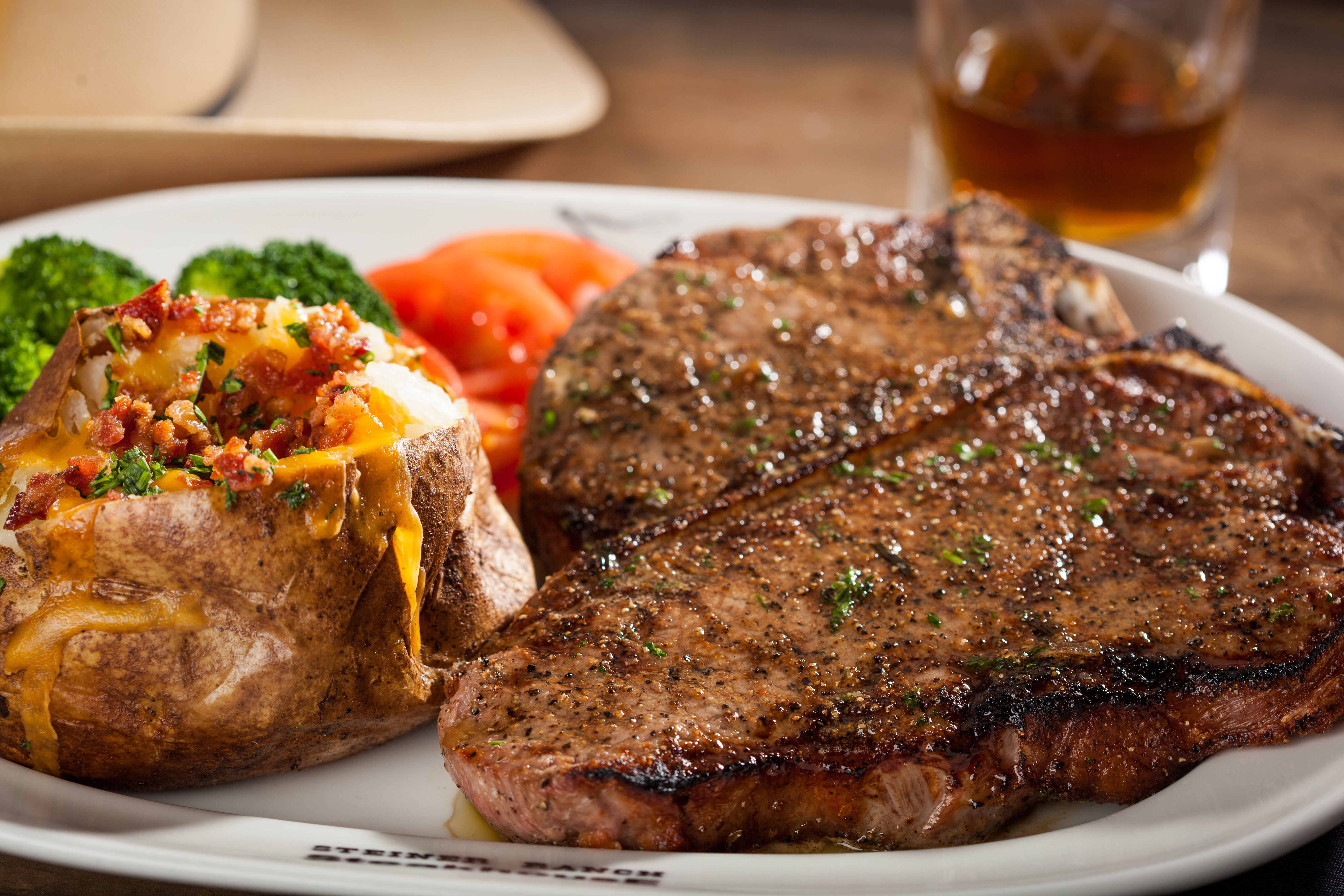
Walk into the Capital Grille in Washington, D.C., on any given night and you’re almost guaranteed to see a few different things, journalist Jessica Sidman reports: glistening platters of filet mignon and bone-in ribeye; bourbon-centric cocktails and pricey bottles of red wine; and a rotating cast of Republican heavy-hitters schmoozing their way through the dim, taxidermy-lined restaurant.
Sidman, a food editor for Washingtonian magazine, has been covering D.C.’s food and drink scene for more than a decade. But during the course of her reporting for a new article for Washingtonian, where she shadowed one Republican lobbyist for an evening while he dined and networked at the Capital Grille, she ended up having “the most Washington night in my entire life in Washington,” she said.

“Capitol Grille is one of the most Republican hangouts in D.C. right now. So I knew I wanted to go there with a Republican lobbyist who knew members of Congress and other politicos, and who could help me spot people and introduce me to this world,” Sidman told The Sunday Long Read. “It was kind of everything I hoped and imagined it would be…it was right out of a movie scene, almost.”
The goal of Sidman’s fly-on-the-wall reporting at the Capital Grille and beyond? Find out why, exactly, D.C. steakhouses have such a stranglehold on the dining choices of Republican politicians, and determine what that choice of food and restaurant might say about our current political climate more broadly.
In other words, Sidman writes, the story is something of a deep dive on the one food “that’s fueling — figuratively and literally — the 2024 election.”
The following interview has been lightly edited for brevity and clarity.
I love the line you wrote where you said: “If Washington is the swamp, its steakhouses are the alligator pits.” I felt like that was a great description. Can you describe what typically goes down in these steakhouses on any given night?
D.C. in particular has long been known as a steakhouse town, and many of the prominent ones are located in the corridors of power, right near the Capitol, near the White House. So naturally, you have a lot of people from different administrations and in Congress going to these places. In D.C., the VIPs tend to be the politicians. And steakhouses in particular have become very Republican-coded over the years. So these are places where there are a lot of fundraisers, there are meetings — sometimes they are bipartisan meetings. There are a lot of lobbyist actions; these are just magnets for lobbyists, so many lobbyists are just hanging out there, just hoping to catch a senator’s eye and maybe get a word in. And [then they can] call back to their client and say, “Oh, I saw so-and-so.” It’s one of the back rooms of Washington.

Join us today, either as a free subscriber or a paying member. Just click here!
You write that Republican PACs have outspent Democrats 13-to-1 [at the Capital Grille], with almost $800,000 worth of [restaurant] bills this election cycle. But it also sounds like it wasn’t always so divided, that there wasn’t always that deep partisan line in steakhouses. Can you talk about that history, when this became such a Republican politician breeding ground or place to meet?
Steakhouses really came into prominence in D.C. in the early 20th century. They’ve always been associated with power and, you know, masculinity. But according to the historians that I’ve talked to, they weren’t particularly partisan; you saw people from both sides of the aisle. And I think that has started to shift in recent decades, kind of with the way politics themselves have become more divisive. And when you think about it, you know, steakhouses really represent a lot of what the Republican Party wants to represent these days. There’s the pure geographic part of it, where steak or cows are raised in typically more red states. But also there are all these other layers and values, of tradition and masculinity. And you’ve seen people like Trump, who is a well-known, well-done steak lover, saying “Kamala is coming for your beef,” that she doesn’t want you to eat your red meat. And it’s kind of become this part of the culture wars as well.
You’ve noted in a lot of your articles that when he was in office, Trump only visited one restaurant in D.C., and that was the steakhouse in his own hotel. Do you think that contributed to this Republican-steakhouse combo, or do you think it was already starting to become a trend before that?
It was already starting to become a trend in years prior. Capital Grille opened the D.C. location the same year that the Republicans took power of the House and Senate for the first time in 40 years. And Newt Gingrich, who was the new speaker of the House right around this time of the opening, made that his regular spot. And it kind of established that place as a Republican hangout. But then, certainly, there has never been a place that seemed as partisan as the Trump Hotel, the steakhouse there — that was the MAGA hub during the Trump years. You could go there pretty much any night of the week and you might spot a cabinet secretary or White House official, or any prominent figures in the party hanging out there. And of course, as you mentioned, for Trump himself, that was the only restaurant he ever visited while he was in office.
So I feel like the logical question is: If Republicans in D.C. have steakhouses, then where do Democrats go? Is there a common place that everyone agrees on, or is it less clear on that side?
That’s a really good question, and it was one that I was trying to ask people about. I don’t think it’s as easy to pinpoint; it’s not like a specific cuisine or a specific place. I think in general, Democrats do tend to gravitate toward the newer, trendier places. And especially when it comes to PAC spending, you see Democrats being a little more conscious of what kind of message it’s sending when they visit a place and spend money at a place. So it’s making a conscious effort to spend money at maybe a Black-owned restaurant, or an immigrant-owned restaurant, or a woman-owned restaurant, and things of that nature.

I guess either way it’s about optics — which I know you talk about in your story — and about sending messages about what this party, what this person, represents.
I was kind of worried when I started this story about if I was going to be able to get a lot of Republicans to talk about how much they love steakhouses. And it turns out they love to talk about it. They were thrilled to talk about it, you know, because it does send a certain message to their own constituents. In a lot of ways the steakhouse is very “America-first,” right? It’s Americana at its core — although, as I write in the story, nevermind if the [parking] valets and the cooks are immigrants — but it does represent a lot of their values as well.
Beyond just the fact that Republicans like steakhouses and steak, can you talk about how the choice of food that politicians choose to eat speaks to their broader politics?
This is a company town, and the company is the government. So a lot of people, even if they don’t work for the federal government, have jobs that rely on it or are tangential to it. And it’s just a population of people that, for the most part, pay attention to politics and the election. There’s certainly a lot of interest when the president or vice president eats around town and, you know, what does that mean? That’s something that people here like to follow and just dissect. I remember one story where Joe and Jill Biden went to eat at an Italian restaurant, and they both ordered the same pasta dish. And people were just going crazy online, discussing the idea of them getting the same dish, versus getting other dishes that they could share, you know. So maybe in L.A., they care about what Angelina Jolie and Brad Pitt are eating, but here we care about Jill and Joe Biden.
I actually didn’t think about that piece of it; I was thinking more about the messaging of food, but of course it’s also about the humanization [of someone] — thinking, “Oh, they’re just like us. What would I order at this restaurant?” Do you think people are interested in that because it’s something that all of us have to do – we all have to eat – that ties us to these larger-than-life people?
Yeah, absolutely. And the thing I love about being a food writer specifically is that it does touch on all these different areas. My beat isn’t just food: It’s economics, it’s business, it’s culture, it’s art, it’s crime — sometimes — and it’s politics. It’s something that everyone can relate to and touches on many different aspects of our lives.
You’ve written about the “Obama bump” phenomenon, that whenever Obama would visit a restaurant in D.C. when he was in office, that it would create a lot of buzz and people would flock to those restaurants. Would you say the ultimate goal for restaurant owners in D.C. is that a big-name politician will show up?
I think it depends who it is, right? The Obamas certainly had a lot of star power when they came to office. And the Obama administration just happened to coincide with this real boom in the D.C. food scene. So when he and Michelle would go out for date night, there was a lot of excitement about it, and people would want to go to that restaurant afterwards. The businesses would see a big spike in traffic and sales in the weeks afterward. That was not true for Trump, and I don’t really think that’s true for Biden; I don’t know if there’s quite that same star wattage for Biden and the kind of places that he’s going. But I do see if Kamala Harris becomes president, she is someone who is also a real foodie, and I can see a similar “Harris bump” potentially, if she’s eating around town as president.
[After] the upcoming election, what do you foresee happening at the Capital Grille and other steakhouses? Will the tone of who wins the election impact business there? Or do you think that at this point it’s an establishment, and it’s probably going to continue to be successful among Republicans?
Capital Grille specifically — that’s a Washington establishment. One of the Republican lobbyists in my story said it’s like the Washington Monument, you know it’s always there. It’s an institution in its own way. And so it might get a bump if there are more Republicans in town, but it will probably thrive just as well if Democrats take over. These places survive administration after administration, Republican or Democrat. It doesn’t really matter.
Compiled by Amanda Ulrich. Photos courtesy of Jessica Sidman and Melissa Skorpil/Creative Commons via Wikimedia.

Leave a Reply
You must be logged in to post a comment.