
FIRSTSIDE PARK in Downtown Pittsburgh is one of those “if you have fun, we will kill you” parks. Privately owned by PNC Bank and located across from its corporate office, the one-acre green space is crisscrossed by curved, spiraling trails that resemble a mutant octopus from above. Weathered metal sculptures of anthropomorphized rabbits and frogs hide among the bushes and tall grass—I think they’re meant to evoke a storybook sense of whimsy and wonder, but they instead come across as uncanny and somehow off, as if ChatGPT generated a piece of public art.

When I visit on an overcast August morning, I’m greeted by an entrance sign that passive-agressively reminds me, please do not SKATEBOARD or LOITER. I sit on an anti-homeless bench—metal dividers prevent you from comfortably lying down—that’s inscribed with an MLK quote (“Life’s most persistent and urgent question is: what are you doing for others?”). Above the quote is a placard aggressively reminding me that this is PRIVATE PROPERTY. Walking the main trail, I step aside when a white cop strides past me. He says something to a Black man sitting on a bench (like literally just sitting there) who then gets up and leaves, the cop seemingly escorting him out.
In many ways, Firstside Park is the antithesis of Second Avenue Park. Established in 1858 as Pittsburgh’s first public park, Second Ave Park was located just one block north and featured a fountain where an alligator gifted from Louisiana lived, apparently terrifying “peaceful female domestics who encountered it in the early mornings when they went out to sweep the pavements.” In the early 20th century, the park served as the heart of Pittsburgh’s Chinatown, a communal gathering space for the 300 Chinese residents who lived and worked in a self-sufficient ethnic enclave.
The park was the first thing to go in 1921, when the City destroyed Chinatown to build Boulevard of the Allies, an elevated proto-highway that also tore up the surrounding streetcar tracks. An article that year from the Pittsburgh Post includes a photo of the wreckage—the street covered with wooden pallets and metal tubes, the buildings that once made up Chinatown cut in half, their interiors exposed to the city. “Many Downtown Streets Resemble Western Town After Visit of Cyclone,” read the headline, “But It’s Only Result of Army of Contractors Making Improvements.”
The “improvements” forcibly scattered Chinatown residents throughout the city and suburbs and beyond. Shopowners shuttered their businesses. Cars replaced public transit and pedestrians. It was a preview of what happened to working-class, minority neighborhoods in The Bronx and Rochester and New Orleans and Charlotte and basically every city in America (perhaps in your hometown as well): raze it, and build a highway through the wreckage.

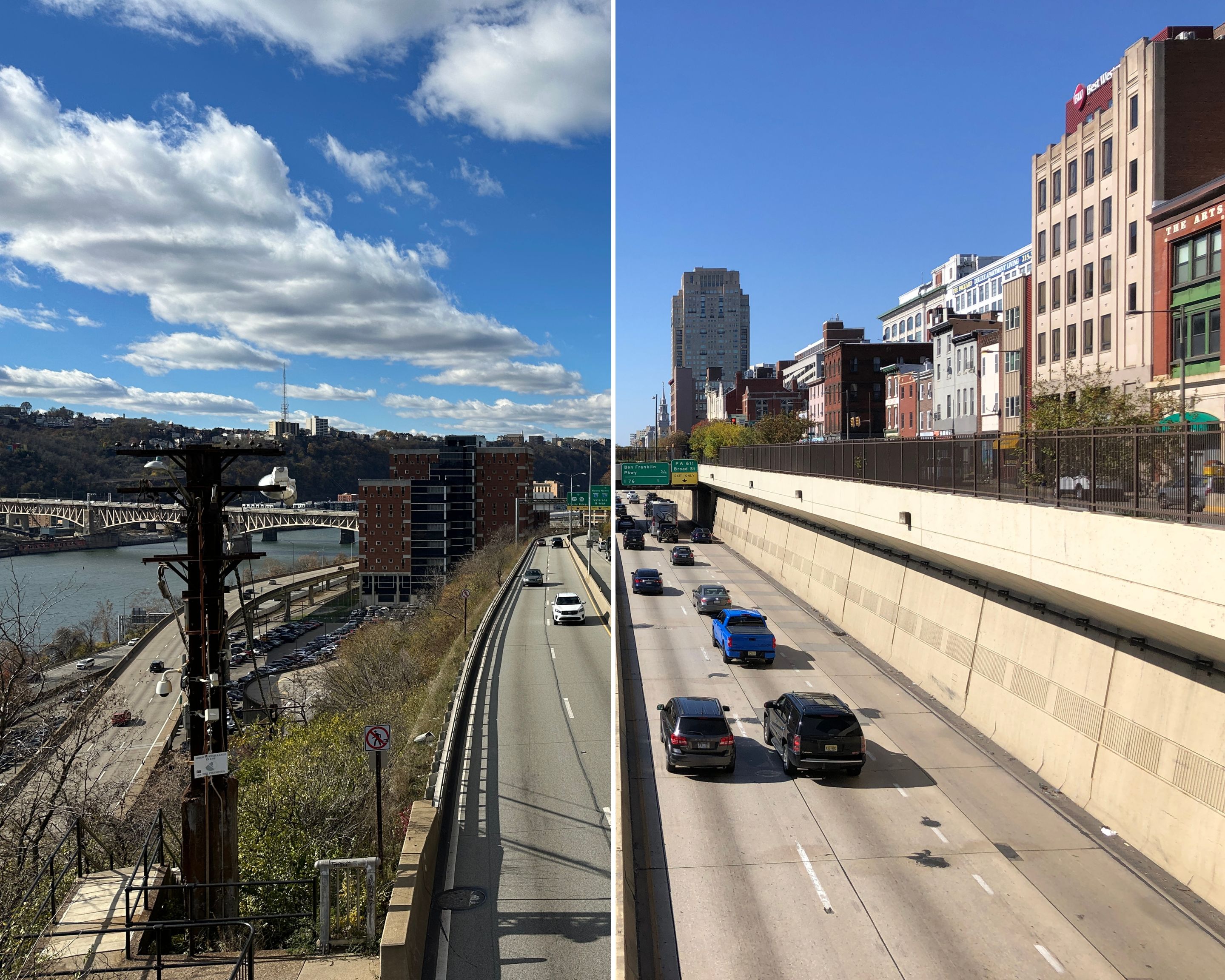
Over a century later, almost nothing of Chinatown has survived. Looking north from Firstside Park, all I see and hear is the constant traffic of Boulevard of the Allies, ferrying drivers up and over Downtown and past the county jail to Oakland, home of the University of Pittsburgh. I first learned about Chinatown when I moved here for my MFA in creative writing at Pitt, where I currently teach. I’m from Bryn Mawr, a suburb of Philadelphia, home to Pennsylvania’s only remaining Chinatown. Growing up, my parents would take me and my sister to Chinatown on weekends, buying Napa cabbage and Lao Gan Ma and everything else we couldn’t get from Acme or Genuardi’s. Almost the exact same thing happened to Philly’s Chinatown in 1991: the City built the Vine Street Expressway on the northern edge of the neighborhood, an inhospitable interstate that’s as noisy as it is dangerous. But unlike Pittsburgh’s, Philadelphia’s Chinatown survived.
As I stand at the edge of a private park owned by a bank that’s loaned over a billion dollars to nuclear weapons manufacturers and gaze at a high-speed road that obliterated a refuge for Chinese immigrants, I can’t help but ask: Why? Why did these two roads through two Chinatowns lead to such different outcomes? How do these outcomes reverberate to the present-day? And as the Trump administration cuts infrastructure and public transit funding and cracks down on immigration, what can the destruction and resilience of Pittsburgh’s and Philadelphia’s Chinatowns tell us about how immigrants find and make their homes?

IN 1872, 300 Chinese people (almost all men, like the overall Chinese population in the U.S. at the time) travelled from California and New Orleans to Beaver Falls, 30 miles downriver from Pittsburgh. The completion of the transcontinental railroad three years earlier meant Chinese migrants had to look eastward for work, going against the flow of white colonizers. White workers at a cutlery factory in Beaver Falls had struck for higher wages. A local reverend suggested that management replace them with Chinese immigrants.
White workers antagonized their replacements, throwing stones and taunting and beating them. Locals amused themselves by pushing Chinese people into puddles of mud on the streets. “Will you let these Mongolians drive out your fellow-Christians and fellow-citizens?” a townsman asked the following year.
“These Mongolians” spent 11 hours a day, 6 days a week lined up in rows on the cavernous, deafening factory floor, dressed in grimy uniforms with cotton plugging up their ears as they forged metal and hammered blades and sharpened knives against sparking grindstones, all for a fraction of what white workers were paid. But there were instances of class solidarity. Management was forced to rehire some of the fired workers, who “got along surprisingly well” with their Chinese colleagues, writes history professor Edward J. M. Rhoads. “Though the Whites had objected to the utilization of replacement workers, their anger had been directed more toward the company than toward the Chinese themselves.” In fact, a few months after their arrival, Chinese employees themselves went on strike to demand higher wages.
When their contracts expired in 1877, none of the Chinese cutlery workers decided to stick around Beaver Falls. Maybe their ears rang from the sharp stabbing sounds of metal against metal; maybe they’d wearily lifted themselves out of the mud as townspeople pointed and laughed one too many times. Many returned to the West Coast. Some tried their luck in big cities like Philly and New York. But others traced the curve of the Ohio River, travelling upstream to arrive at the confluence of the Allegheny and Monongahela, where the three rivers merge to form the City of Pittsburgh.
By 1920, hundreds of Chinese Pittsburghers lived and worked Downtown in a single city block between Grant and Ross Streets and Second and Third Avenues. Second Ave was nicknamed Chinese Wall Street for its commerce and crowds. Chinese workers were barred from the factories and steel mills lined up and down the banks of the rivers overflowing with raw sewage; locked out of the industrial labor force, they instead opened up restaurants and laundries. Maybe factory owners didn’t need to exploit Chinese people anymore—there were more than enough arrivals from Europe who came to the city by the hundreds of thousands.
On their off hours, the mostly white factory workers (in 1910, only 3% of the iron and steel workforce was Black) would pop into the ubiquitous narrow storefront of a Chinese laundry and drop off bundles of soiled clothes on the counter. What was life like behind that counter? What goes through the minds of laundrymen scouring stains with bleached and sudsy water, hanging lines of dripping clothes on steel wires between strategically positioned gas burners, gripping six-pound cast irons they sweep up and down steaming fabric, their hands yellowed with a crust of callouses?
Do they try to recall the faces of their families back in Toisan? Retrace the streets they ran through as children? Maybe they sing to themselves or recite poems they learned in school, trying to hurry the twelve-hour shift along. With their backs and legs and wrists aching from standing and bending and lifting they close up shop on Saturday night, shovel whatever passes for dinner into their mouths, hang up their work clothes on exposed nails hammered into plywood, and lower themselves onto thin mattresses shoved into dusty corners, finally sleeping soundly in the knowledge that tomorrow is Sunday.
Sunday. The lone day the laundrymen leave their shops closed—scattered throughout the city and in mill towns like Braddock and Duquesne and Donora, even as far afield as Ohio and West Virginia—and converge on a single block Downtown.
They step through the doors of restaurants and shops and civic organizations with facades painted deep red, resupply on detergent and ironing pads, buy caskets of slow-fermented soy sauce the color of honey, run their hands over soft sheets of thin silk imagining a wardrobe full of finery rather than once again wearing the same set of shirt and trousers, bring strips of oil-bathed duck to their mouths and savor the fat dissolving on their tongues, drop pinchfuls of tea into porcelain cups, lower their voices and mumble to the proprietor that this week they don’t quite have the cash on hand to cover their expenses, but next week—next week—they would be back with the necessary funds—swear on my life, you can take my word and my word is as good as the gold we named this country after—raising their eyes at the crack of wooden beads sliding across the rungs of an abacus, the shopkeep faintly smiling and saying I know, of course I know you’re good for it.
Relieved but ashamed, they say their thanks and take their leave and wait for streetcars to rumble past before crossing the street to the narrow strip of green space that is Second Avenue Park, the alligator that terrorized “peaceful female domestics” thankfully nowhere in sight. You know how important that is—to not only have a neighborhood where you can speak your own language and eat your own cuisine and slip into smoke-filled backrooms and say deal me in and scan your hand and take the corner of your best card between your fingers and raise your weary arm and bring it down hard with a SLAP—but a place where you can just sit outside. And read a newspaper. Or a book. Or turn to your neighbor and shoot the shit about news from home, about the revolution that just brought down millenia of dynastic rule, not thinking about work for a precious few moments in this island of life in the ocean of smoke and smog that is Pittsburgh.
When the city built Boulevard of the Allies in 1921, 8 years after planners and council members first proposed the project, “Chinese residents likely had little political sway,” reported local public radio station WESA. “County Commissioner meeting minutes about creating Boulevard of the Allies don’t mention Chinatown at all.” A search for “Chinatown” in the City’s digitized public records yields no results, either. The Exclusion Act prevented Chinese Americans from ever gaining citizenship; many of them were here under false names on false papers. They had no voting power, no voice, and it seems no one bothered to consult them. Maybe there was just too much money at stake: the Boulevard cost $1.6 million per mile (over $18 million today), making it the most expensive American roadway at the time.
After getting off the bus on an overcast August morning and walking to Grant Street, I manage to cross the Boulevard in 20 seconds—the three lanes of the ramp itself and the one-way local lanes that flank it. This area of Downtown is basically chasms of concrete. Further towards the Monongahela is the tangle of ramps leading on and off the Parkway, a prime example of the American obsession with destroying waterfront access for pedestrians.
Across from the Boulevard, Second Ave is (for whatever reason) lined with law offices for Gaitens, Tucceri & Nicholas and Tarasi & Tarasi and Pribanic & Pribanic (still under construction). As I take notes on my phone at the corner of Second and Grant, two Black men walk past me. “Jet Li, what’s up?” says one, while the other chuckles. There needs to be a term between microaggression and hate crime. Macroaggression? Micro crime? Whatever you call it, it feels worse coming from a fellow minority. The tried-and-true tactic of pitting different marginalized groups against each other still works.
I round the block and enter the Chinatown Inn restaurant, the only surviving business at 522 Third Ave. I’ve never actually gone in because I’m not the biggest fan of American Chinese food—I don’t think it’s “inauthentic” or whatever, it just doesn’t taste like what my mom made for me as a kid. I walk past the two fish tanks and take a seat in a red leather booth. Towards the back are two workers taking their lunch break, chatting to each other in Mandarin. Soft piano music plays in the background. I order a plate of pork dumplings, and as I wait, I try to find the right term to describe what happened to Chinatown.
Because Chinatown didn’t “disappear.” Avoid the passive voice, I tell my writing students at Pitt—who or what is the subject of the sentence? The Boulevard of the Allies destroyed Chinatown. But that’s not the full story. Hundreds of residents didn’t just leave overnight, immediately abandoning dozens of businesses. How about this: the Boulevard of the Allies slowly choked the life out of Chinatown. Over the course of several decades, the Boulevard decreased foot traffic and transit access to Chinatown—prioritizing the needs of motorists who could speed past and over the neighborhood—compelling residents and business owners to move out and close up shop.
By 1959, only 30 people lived in Chinatown. After decades of treating their bodies like machines, the old laundrymen were thoroughly worn out. Many of them lived out their final days on the top floor of the On Leong Merchants Association building, next door to Chinatown Inn at 520 Third Ave. I’m trying to find a way out of this story, of the immigrant who leaves everything he knows and everyone he loves to live and work in a country that hates him—like truly hates him, doesn’t want him here, forces him to lie about who he is and what his name is just to get in—and once here he spends almost every day of every week, month, and year washing and drying and ironing the clothes of white people working jobs he can’t have, breaking his body and mind just to end up destitute and alone, lying on a thin mattress shoved in a corner and falling asleep to the sound of traffic from the Boulevard.
But I think that’s the story. “They were in bad shape,” says retired Carnegie Mellon professor Shirley Yee, who remembers visiting the laundrymen with her father. “They were very old and needed a lot of help. But they were always happy to see my father.” Shirley’s father, Yuen Yee, acted as the unofficial mayor of Chinatown. He accompanied people to interviews with immigration officials and interpreted for them, gave quotes to the press, and set up the laundrymen’s makeshift retirement home. When a laundryman died, Yuen made sure he got a proper burial, cemetery plot, and gravestone.

Before his death, Yuen wrote rich, detailed memoirs of his experiences in Chinatown. Shirley generously shared them with me; my descriptions of Chinatown in its heyday are based on Yuen’s writings. Yuen spent much of his career as a cook, maitre d’, and manager at Chinatown Inn. Even after he retired, he’d still pick up shifts at the restaurant. The pork dumplings I ordered have a soft, thick chewy wrapper, almost like mantou—again, it’s not quite for me, only because it’s not like my mom’s lamb dumplings. I finish my meal, pay in cash, drink one last cup of tea, and leave. Outside the restaurant is a historical marker that the local chapter of the Organization of Chinese Americans finally secured in 2022. “Despite displacement initiated by the 1920s Blvd. of the Allies,” it reads, in a real tour de force of passive voice, “Chinese ethnic identity continued in the region.”
Which I suppose I’m evidence of.
And with that, I leave.

SO: LEAVE Chinatown, or what remains of it.
Get in your car as God intended and drive east on Boulevard of the Allies. Exit right and merge onto the Parkway (I-376), through the Squirrel Tunnel, past Swissvale and Monroeville before entering the PA Turnpike (I-76), which PennDOT somewhat defensively maintains is “not the most expensive toll road.” Put on a playlist or cue up some podcasts as you wind up and around and down and through the Allegheny Mountains before flattening out as you cross the Susquehanna flowing past Harrisburg. Admire the billboards that scream at you that There IS Evidence for GOD and SHACKLED BY LUST? JESUS SETS FREE. Speed through the cornfields of Amish Country, counting the cows and horses as barns give way to exurban McMansions before slowing down and hitting traffic by the always congested King of Prussia interchange.


Watch out: you’re now on the Schuylkill Expressway, where Jennifer Lawrence’s husband was hit and killed in Silver Linings Playbook, a highway wedged between the eponymous river and a sheer cliffside that’s so narrow and dangerous and poorly designed that, according to what my friend told me in seventh grade, the highway’s designer killed himself out of despair, a story that will definitely not pass The Sunday Long Read’s fact-checker but which I still like to tell. Look: there’re those rowing clubs that light up at night. There’s the Art Museum with the Rocky steps, which I tried to get a slinky to slink down during a seventh grade field trip (it didn’t work). Cross the river and merge onto the Vine Street Expressway (I-676), tunneling beneath the Parkway through Center City as you finally exit at 15th Street, driving just a few more blocks east before arriving at your destination:
Chinatown.

And holy hell is it hot when I visit last summer, the 98-degree heat reflecting off the treeless sidewalks. (Chinatown has one of the lowest rates of tree coverage in the city, just 2.5%.) I’m here to figure out why, unlike Pittsburgh, this place still exists—why today there’re old ladies sitting on milk crates selling cabbages laid out on sheets of cardboard and tourists snapping selfies with the ornate, red and blue pagoda-roofed Friendship Gate (designed by artisans in Philly’s sister city of Tianjin) and middle school-aged kids running past me and across the street without bothering to check the light. Chinatown lacks green space for kids to safely play in. There’s Franklin Square, but you have to walk past a block-sized parking lot and the old police headquarters to get to it. As a result, the narrow streets serve as a de facto, and dangerous, playground for local kids.
When I was a kid, my parents would take us to Chinatown for groceries, my mom maneuvering through narrow aisles of sauces and spices and snacks to the live fish tanks at the back of the store and point to an unlucky specimen that the fishmonger would scoop out with a shallow net, lay flopping on a cutting board, and WHACK with a rolling pin before bagging and handing across the counter. As a high schooler, I’d stop by Nan Zhou Hand Drawn Noodle House and order a steaming bowl of beef noodle soup—always, always with a fried egg on top. In my sophomore year I volunteered for PBL (Project Brother (not Brotherly) Love), spending the night in sleeping bags in the pews of CGC (Chinese Gospel Church) on 12th St—along with other suburban kids from PVCCC (Peace Valley Chinese Christian Church) and CGCC (China Grace Christian Church) and WCCEC (West Chester Community Evangelical Church) and my home church of TCCGP (Trinity Christian Church of Greater Philadelphia)—before spending the day at the original 10th and Spring location of CCC&C (Chinese Christian Church & Center, otherwise known as C4 (we joked that it was an EXPLOSIVE church)), running a VBS (Vacation Bible School) for local kids.


CCC&C has a newer, second location on the other side of the Vine Street Expressway at 11th St; we’d cross Vine to attend service there on Sunday mornings. “Cross” doesn’t capture the experience of getting to the other side of Vine—it’s more like 38 seconds (I timed it) of battling your way through three lanes of eastbound local traffic, speedwalking across the concrete pedestrian bridge spanning six lanes of constant interstate traffic, and finally breaking into a run across the final four lanes of westbound local traffic, the walk sign somehow calibrated to just barely not give you enough time.
Vine Street was dangerous even before the expressway was built, a 12-lane boulevard with medians separating traffic into four sections. Pretzel vendors would walk up and down the narrow strips of concrete, trying to entice drivers to buy a mid-commute snack. In 1966, PennDOT announced their plans for the Vine Street Expressway: widen Vine even further and add north-south highway ramps, establishing a concrete moat on three sides of Chinatown and, crucially, destroying Holy Redeemer Catholic Church and School.
Ethnic churches are more than churches. When my parents arrived in Norman, Oklahoma from Beijing, the local Chinese church gave them furniture for their new apartment, rides to the grocery store, ESL lessons, and more. Holy Redeemer served the same function. Established in 1941 as the first Catholic Church in the U.S. specifically for Chinese worshippers, it hosted weddings, funerals, graduations, dances, and film screenings, along with providing all the basic services and assistance new immigrants need to survive.
The threat to the church outraged residents. Holy Redeemer graduate Cecilia Moy Yep gathered 250 of her neighbors at the local On Leong Merchants Association (the same organization that provided a home for the retired Pittsburgh laundrymen). Galvanized by mass opposition to the Expressway, Cecilia and her brother-in-law George Moy founded the organization that would become the Philadelphia Chinatown Development Corporation.
“We don’t have the voting power, we don’t have the money,” says John Chin, current executive director of PCDC. “We have time on our side and we have media on our side.”
“Time is money for people, people who have power and money,” he explains. “Time is horrific to them. They don’t have time, but we do. We can wait ‘em out.” After the announcement of the Expressway, Chinatown residents attended and protested hearings at City Hall, travelled to Harrisburg by the busload to speak with state officials, petitioned the Archdiocese of Philadelphia (which was initially willing to sell Holy Redeemer, as it wasn’t profitable) to preserve the church, and initiated an EPA environmental impact statement that went through multiple drafts and iterations over the course of several years.

“Let’s stall, stall, stall,” John continues. “Let’s get legal counsel to file some lawsuits. Force them to do the environmental study and things like that. The longer we stall, the more expensive something gets and the longer it takes.”
It sounds like John is describing guerilla warfare. Faced with an overwhelming outside force, the local population can win by successfully playing defense. They have time on their side—so what about the media? “Media is always looking for an auto accident, if you know what I mean,” says John. “Just horrific news. They want news that’s shocking, and protests are shocking. Once you get the media, we can tell our story, our narrative.”
At 6 am on August 2, 1973, activist Mary Yee woke up to a shocking phone call: a construction crew had started demolishing buildings on Winter Street to make way for the Expressway. “I said, we gotta stop this,” remembers Mary. “We’re gonna go and just stop the bulldozers.”
Mary grew up in Boston’s Chinatown, which was decimated in the ‘50s by the construction of the Southeast Expressway, destroying half the neighborhood’s housing and scattering her friends throughout the city and suburbs. By the time Mary moved to Philly, the civil rights movement was in full swing. Mary and her friends had been radicalized by opposition to the Vietnam War. They were American citizens and, crucially, bilingual.
“ The first generation said, ‘We can’t fight City Hall,’” Mary tells me. “The second generation said, ‘This is unjust, we are gonna fight it.’” Mary acted as a bridge between the two. She started a bilingual newspaper called Yellow Seeds, which kept the first generation up to date about the Expressway. “ The restaurant workers and owners basically saw us as like their children or nieces and nephews … because we could speak Chinese,” she says.
This is what Pittsburgh’s Chinatown lacked a half century earlier: U.S.-born, civically engaged Chinese Americans who could navigate the politics of City Hall, and convince their parents’ generation that you can fight City Hall. It was this conviction that inspired Mary and 19 others to rush to Winter Street on that August morning in 1973. Wrecking crews had already reduced the homes and businesses into three-story mounds of rubble, jagged piles of raw material where people once lived and worked and played. Mary and the group of activists didn’t have excavators or cranes or tractors operated by construction workers backed by the full force of the local, state, and federal governments—but they had their bodies, which they used to climb the rubble and halt the machines.
“Eventually they stopped. I mean, it didn’t take that long,” Mary says. “And most of the operators who were African American said, ‘We understand what you’re doing, we’re not resentful.’ ” They unfurled banners—PEOPLE NOT CARS, HOMES NOT HIGHWAYS—as passersby pointed and gawked. An Inquirer reporter and photographer captured the moment, and a newscaster from NBC10 mounted the rubble himself and interviewed the group. At 2 pm, the head of PennDOT met with the protesters and agreed “to suspend demolition in Chinatown until the community’s objections to the widening of the Vine Street Expressway are resolved,” reported the Inquirer.
I tell Mary it must’ve taken a lot of courage to do what she did. “When you’re young and you’re mad, you don’t really think,” she says. “Well, you do think, but you think, ‘So what?’”
As unsightly and dangerous as it is, the current design of the Expressway, which finally opened in 1991, is much less devastating than what PennDOT initially proposed. The fact that it’s fully below street-level with 9th and 11th Streets untouched is the direct result of the combined efforts of activist groups, community organizations, churches, and ordinary people—immigrants and U.S.-born, young and old, workers and students, speakers of Toisanese and Cantonese and Mandarin and English or some combination of the four—living in Chinatown, throughout Philadelphia, and the suburbs. It took just 8 years for the City of Pittsburgh to announce, build, and complete the Boulevard of the Allies; it took 25 years for the City of Philadelphia to complete the Vine Street Expressway, which unlike the Boulevard wounded but didn’t kill Chinatown.
In 2023, the U.S. Department of Transportation awarded PennDOT and the City a $158 million grant to heal that wound. Dubbed the Chinatown Stitch and spearheaded by PCDC, the project would cap the Expressway between 10th and 12th Streets—replacing the concrete gash with parks and green space, so that kids don’t have to play in the streets anymore. “Chinatown had a lot of sewing factories,” says John Chin, when I ask him where the “stitch” name came from. “It’s about healing the community. It’s about pulling back the community together that’s been separated.”
This May, with the passage of Trump’s budget bill that cut $2.5 billion of funding to USDOT, the Stitch lost $150 million in federal funds. The future of the project is uncertain, but Mary Yee remains optimistic. “Let’s wait till another administration comes in,” she says. “I think it’s basically all delayed.” I’m inclined to believe her: a quarter century passed between the Expressway’s announcement and opening, and another two decades and change passed before undoing the Expressway became a real possibility. In the interim, Chinatown has fended off a litany of development projects—a baseball stadium, a casino, and most recently a basketball arena—while continuing to act as the sun around which Chinese American Philadelphians orbit.
“Chinatown is always gonna be the center of authentic Asian American heritage and celebration,” says John Chin. We’re sitting in the copier room of the PCDC office; we can hear traffic from the Expressway through the window. There’s that term: “authentic.” John had used the term in an interview in 2024 with Philadelphia Magazine, explaining why he, PCDC, and pretty much every Chinese person living in or from the Philly region was opposed to the basketball arena. “We are an authentic hub for Asian American culture,” he told the magazine. “Are these event-goers coming here to experience the authenticity that we offer? Or are they going to want more sports bars? More athletic apparel shops? More sandwiches, less dumplings?”
Reading or hearing the word “authentic” triggers a mild panic attack among Asian Americans—at least the ones with useless degrees in the liberal arts. So when John uses the dreaded word, I jump on the chance to finally ask him: What does authentic mean?
“Authentic means you come here and you know that this isn’t a Disneyland neighborhood where you can experience great tasting food for a night and then go on your way,” he tells me. “ Chinatown is a draw because it gives one who’s Asian, especially who’s Chinese, a sense of belonging. It gives one a sense that when I’m in Chinatown, I’m the majority. In America, outside Chinatown, I’m a minority.”
If Pittsburgh’s Chinatown still existed, if within just a single Downtown block I was the majority, that guy wouldn’t have called me Jet Li. If he did, he would have to say it to every Asian man in the vicinity, which would’ve taken him all day. “We can claim this as our home,” says John. “You’re from Bryn Mawr. You can come in here and say, ‘Hey, this is my second home.’”
And with that, I go home.

IF CHINATOWN is an ethnic enclave, I grew up in an ethnic archipelago. Scattered throughout the mostly white suburbs of Philadelphia were tiny islands—the basement of my friend’s house where we played COD4 and ping pong, the cafeteria of the church where we’d complain about the food that arrived in buckets, the second floor food court of the Upper Darby H Mart we’d take the Norristown High Speed Line to afterwards—where I and my friends and my parents and my parents’ friends were, at least within the walls of the building we occupied, at least for a little bit, the majority.
I don’t believe in God anymore, so the island of church is gone for me. Almost all my friends have moved away, to Boston or Berkeley or wherever school or work takes them, and the islands of their basements have disappeared as well. My parents bought a home out in the country, in Hershey, and are planning on selling my childhood home in Bryn Mawr. Every time I return there’s less furniture, fewer family photos on the walls, more empty space. When I walk around my neighborhood, I feel lonely. Then again, I always did.
It’s so fragile, isn’t it? This delicate patchwork of people and places and spaces we call home. Home isn’t something that comes naturally, not for immigrants and their descendants. In a nation that makes it so difficult, historically and today, for certain Americans to feel at home in America, from the Pittsburgh laundrymen who bypassed the Exclusion Act only to die penniless and alone to the millions of migrants and refugees whom masked ICE agents are currently terrorizing, home is something you have to actively create and maintain and defend. If you don’t, the proverbial powers that be—the owners of sports teams and telecommunications corporations, the elected officials they donate campaign funds to, the engineers and planners and technocrats who bloodlessly submit plans to raze entire neighborhoods, the squadrons of heavily armed agents kicking down doors and shattering families—will take one look at your home and tell you it’s not yours.
“Home is where you are loved and feel love and have love and give love,” says Shirley Yee, the daughter of the unofficial mayor of Pittsburgh’s Chinatown. To feel and have and give love, you need stable housing. You need access to food and transportation and education and healthcare. You need to be able to walk down the street without fear of being yelled at or harassed or arrested for simply being who you are.
Chinatown provided that safe haven for Chinese Pittsburghers in the early 20th century. But today, Shirley says she doesn’t mourn Chinatown’s destruction. “The Chinese community found a way to assimilate, to be part of the greater Pittsburgh community,” she tells me. “It’s sad that Chinatown is just one restaurant now. But in the end, Chinese people did go on and have fulfilling lives in other neighborhoods outside of Downtown and throughout Pennsylvania and the whole area. So no regrets, really.”
Shirley’s comments took me by surprise. Here I was, poring over newspaper clippings and old photos and academic articles about Chinatown, while someone who actually remembers the neighborhood says she doesn’t miss it. Why am I so interested in what a single city block was like over a century ago?

I was put in touch with Shirley by a mutual friend, Lena Chen, who made a documentary about Chinatown and wrote an essay about how “uncovering Pittsburgh’s long-hidden Asian American history made me feel at home.” My story is essentially the same as Lena’s: when I first moved here I also spent hours researching Chinatown, searching (I suppose) for a larger narrative I could write myself into. Maybe if I could belong in this city’s story, I could belong in the city itself.
I live in Squirrel Hill, a neighborhood that’s popular with Chinese international students and now acts as Pittsburgh’s unofficial Chinatown, home to the KTV bar where I sang (because I’m desperately uncool) “One” by U2 on my wife Grace’s 21st birthday party, the Taiwanese restaurant with unbeatable soup dumplings that my parents take me to when they visit, and the approximately five million boba shops that quite frankly are all kinda the same. In a sense, that passive voice historical marker is right: “Chinese ethnic identity continued in the region.”
But having talked to activists and community members who fought for the survival of Philadelphia’s Chinatown, I realized that the destruction of Pittsburgh’s Chinatown was more than the demolition of physical structures—it was the severing of a shared history.
Asian Americans have to constantly relearn the history of Asian America; each successive wave of immigrants has to start from zero. Philly’s Chinatown provided new arrivals with a pre-existing ecosystem of businesses and churches and neighborhood organizations, as well as institutional knowledge of tactics (time and media, as John Chin put it) to preserve that ecosystem. Historic Chinatowns, in Philly and across the country, provide continuity.

In Pittsburgh, there’s a forced gap in that continuity—a gap in the past I’m trying to restitch while also planning a future here, in the city where Grace and I met and studied and fell in love and now live and work.
We got married this year. We drove Downtown and parked in First Avenue Garage, across from PNC’s corporate office. We walked through Firstside Park (taking care to please do not SKATEBOARD or LOITER), beneath the Boulevard of the Allies ramp, past Chinatown Inn and the historical marker, along a fenced off vacant lot, and into the City-County Building. We took a seat in the waiting area of the Allegheny County Marriage Bureau. A county worker called our names, asked us some questions, and printed out our marriage certificate. It was more difficult for Grace to switch their driver’s license from New York to Pennsylvania than to get married in Pennsylvania.
I sent Grace an annually recurring Google Calendar event: “legally married!” They took a screenshot and posted a close friends Instagram story making fun of me for it. We got in the car and drove beneath the Boulevard back to our apartment in Squirrel Hill.
Three months later, Grace hosted an informal literary salon for their 28th birthday. We spread a picnic blanket on the living room floor and set up a makeshift stage by the record player. For most of my life, I didn’t know who “my people” were; I felt out of place among the other engineering majors at Penn State and the other Christians at the college fellowship I attended. As writers and artists and musicians and weirdos of all genres read and performed poems and flash fiction and songs, I felt something strange. I felt like these were “my people,” like I was part of something bigger than me, a community that my now wife and I belong to.
I felt at home.

Boen Wang
Boen Wang is a writer, audio producer, and educator in Pittsburgh. His audio work has appeared in This American Life, Radiolab, and elsewhere. His written work has appeared in The New Republic, Waxwing, and elsewhere.
This story was made possible by the support of Sunday Long Read subscribers and publishing partner Ruth Ann Harnisch. Edited by Kiley Bense. Designed by Anagha Srikanth.
Leave a Reply
You must be logged in to post a comment.