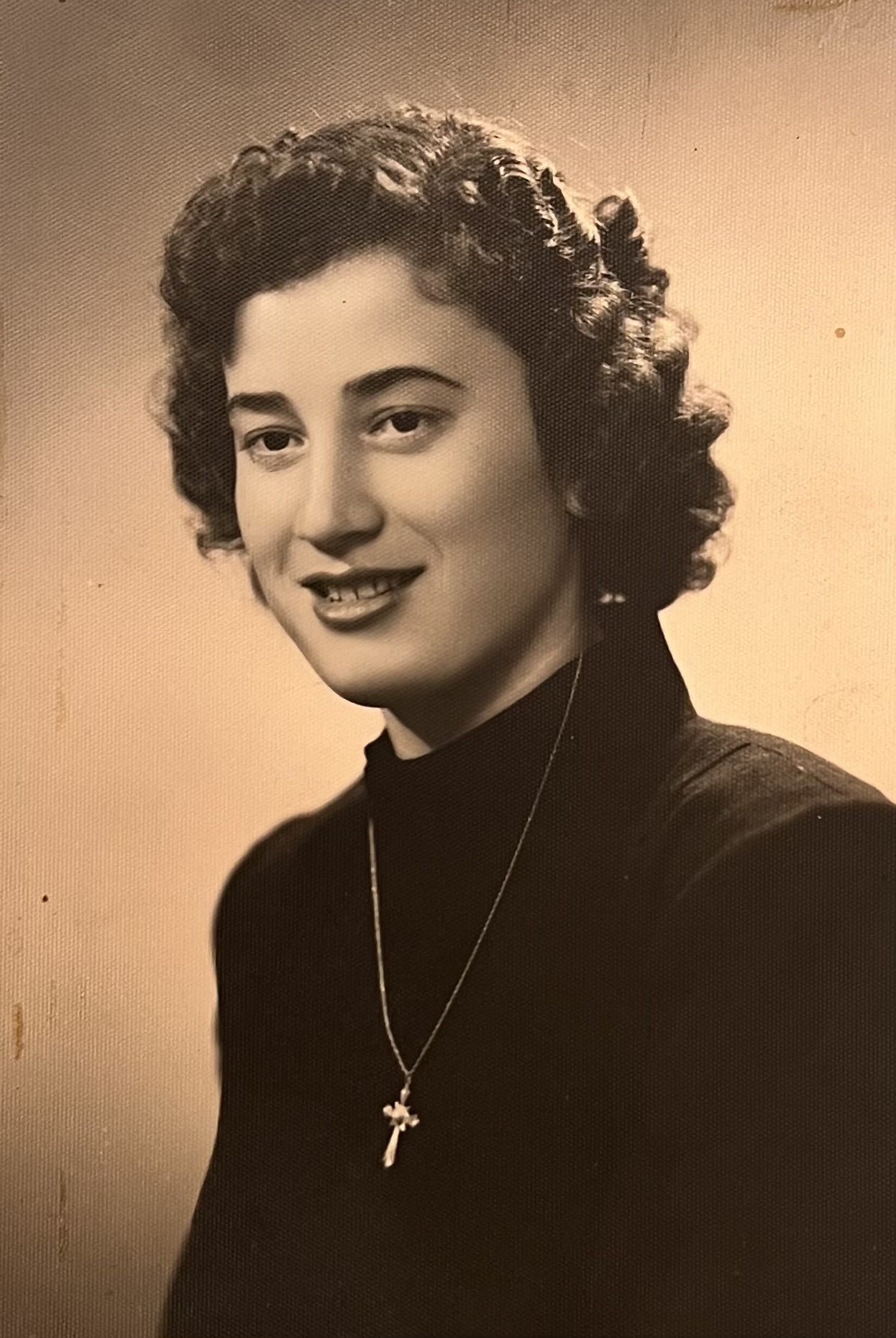
IN THE last months of her life, my grandmother started mentioning an unfamiliar name: Tony. At first, the name appeared in brief inquiries, like I wonder how Tony is or I wonder where Tony is. I didn’t think much of it. She was in the late stages of Alzheimer’s, and names had been slipping off her tongue for quite some time. The remarks eventually turned into questions she wanted answers to: Did Tony ever get married? Did Tony have kids? Did Tony… Did Tony… Did Tony…? I’d respond truthfully and tell her that I didn’t know who Tony was. But the more her illness progressed, causing her to forget even my name, the more she held onto this other name. When she’d wake up in the middle of the night to go to the restroom, she’d often pace throughout the house, unable to find it. For a long time, I’d wake up and walk her there, then back to her room and she’d fall back to sleep. When she stopped recognizing me and I’d appear from my room, she wouldn’t know who I was or where she was. She’d look out the window, see that it was dark, and panic. Call Tony! Tell Tony to come and get me! I had travelled thousands of miles to help care for her and, in return, I was being told to call someone else, someone I had never heard of–a stranger to me, a comfort to her.
Her Alzheimer’s diagnosis arrived while I was in graduate school for creative writing at Columbia University. While my family grappled with this news in Los Angeles, I was on my own in New York City, trying to make sense of what this illness would mean for all of us. At orientation, I’d learned that the Manhattan campus had been an insane asylum before becoming a university. I thought about this detail often as I reflected on a devastating reality: while I worked to build the metrics of my own mind, my grandmother would be losing hers. What I didn’t understand then, was what that actually meant. When we think about losing memory, we think of that loss as absence, erasure, a void. Doctors prepare families by telling them that their loved ones will forget people, places, time, names, and words. No one tells you what they’ll remember in place of all these things. No one tells you they will forget you so that they can remember someone else.
Grandma, who’s Tony? I once asked her when she was lucid. She gave me a suspicious look and asked me where I brought that name from. I told her she’d mentioned it several times; she denied that she had and insisted that I was mistaken. She immediately changed the subject, so I let it go. I asked my father and mother and aunts if they knew who Tony was. Everyone told me they had no idea.
My grandmother was a talkative woman in all four of the languages she spoke, but she had never told me anything about anyone named Tony. Who was he? And how could I unravel a secret hidden in a name that my grandmother denied recognizing but couldn’t stop saying? I didn’t know where to start.
Where do you begin when all you have is a name? A name that doesn’t reveal much about its holder. Unlike the notably Armenian names in my family, the name Tony could belong to mostly anyone. I couldn’t place the name to a specific time or place in my grandmother’s life. All I knew for certain was that the only place to start was at the beginning, and the beginning for my grandmother was a town along the Turkey-Syria border.
My grandmother’s parents were Armenian Genocide survivors who were born in Kilis, a province in the Ottoman Empire in what is now Turkey, where many Armenians didn’t speak Armenian out of fear of discrimination and violence. When the massacres against Armenians began in the early 1900s, her parents were young children. Her mother, Arshaluys, never forgot the murder of her own mother or how close she’d come to starving to death herself. Arshaluys survived and found refuge across the border in Azaz, Syria. There she met my great-grandfather, Setrak, a fellow Armenian refugee from Kilis, whose entire family had also been among the million Armenians killed across the empire. Like her, he didn’t speak Armenian. He was a baker, which meant something to her: their children would never starve like she had.
As the only survivors in their families, my great-grandparents married and had six children. Although Turkish was their only language, they sent all six of their kids to Armenian school, ensuring that they’d speak, read, and write Armenian. The most important thing for them was that their stories of survival would survive in Armenian, and their mother tongue, which had been forcibly taken from them, would become theirs again. My grandmother, their fourth child, was born in 1938. They named her Zvart, which means happy in Armenian. My grandmother was always mad about being named “happy.” She wished her parents had named her something less prescriptive. Still, when I was born, she insisted my name be Zvart but settled on making it my middle name, passing on the burden of an impossible destiny.

Although my grandmother’s first language was Turkish, it was Armenian–her second language–that became her sacred language. During the genocide, when Armenians were forced into death marches through the Syrian desert, the women would use their fingers as pencils, sand in lieu of paper, to teach their starving children the Armenian alphabet. Unlike many of these women, Western Armenian had not been my grandmother’s mother tongue but like these women, this language would become a source of sustenance and resistance. She passed on not only the Armenian language but the duty to uphold it. She raised her children with Armenian as their mother tongue. It is one thing to preserve and pass on something you already have. It is another thing to bring something lost, something long gone, back to life. My grandmother’s responsibility was to resurrect a language that had been erased. My brothers and I were born in California but raised in a home where English was banned, a rule enforced not only by my parents but by my grandmother, who lived with us. “Speak Armenian!” she’d shout, always threatening to stuff our mouths with red pepper if we uttered another word in English.
The same grandmother who’d reprimand her grandchildren for not speaking Armenian would plant her lips on the tops of our heads while whispering habib albi, ruhi, omri. As a child, I thought these words were Armenian. Well, I assumed any word that wasn’t English had to be Armenian, since it seemed to be the only language allowed to live alongside us. I now know that the language of my grandmother’s affection–of calling us the love of her heart, her soul, her life–was in Arabic, the third language of my grandmother’s life. When my father and mother and aunts and uncles spoke English or French or Turkish, my grandmother would make them switch their tongues to Armenian. But when they spoke Arabic, she never told them not to. Of all the languages my grandmother spoke, Arabic was the one she favored. I always knew this to be true but never understood why. Was there a connection between Arabic and Tony?
Words are like people. They have roots and origins. They act as neighbors to one another. There are rules to govern the way a word should act. Some behave, others misbehave. Like people, words have personalities–they can be possessive or accusative or interrogative. Like people, words belong to a larger family–a particular language. And words of a particular language are meant to be neighbors with other words of the same origin. I am writing this essay, for example, in English and mostly only English, so that you can understand what I’m trying to tell you. But if I were to tell my grandmother’s story properly, I would use five languages, three of which I do not actually know.
Like many genocide-surviving Armenian families, my family’s dialect of Western Armenian is not purely Western Armenian. It is Armenian, Arabic, French, Turkish, and English. Sometimes, I catch myself saying three-word sentences while I speak “Armenian,” but each word is from a different language. For example–tazah fraise guzes? Tazah is the Turkish word for fresh, fraise is the French word for strawberry, and guzes means “do you want” in Armenian. A simple question, an offering of strawberries, tracks my family’s history of displacement. These “foreign” words come naturally to me. It never occurred to me that the words we speak so harmoniously are not meant to be spoken together or that these words might not long for or belong to one another. But my grandmother must have known this because she approached each of her languages with intention and sometimes even secrecy.
For the longest time, I thought my grandmother did not know English because that is what she told me. I did wonder why it was that she’d never miss an episode of All My Children and General Hospital if she couldn’t understand what they were saying. But then I’d watch Arabic films with her and sing Arabic songs without understanding them, so I guess I didn’t think it was all that strange. It wasn’t until my 20s that I realized English was my grandmother’s fourth language. She’d been taken to the ER. I rushed to get there before the doctors did so that I could translate for her. I arrived as soon as I could and scurried down the hall, looking for her room when suddenly, I heard my grandmother’s voice–speaking English. I walked in to find a doctor at her bedside, listening intently, as my grandmother described her pain. She was unfazed by my arrival and immediately introduced me to the doctor.
“This is my granddaughter. She’s in law school.” I shook his hand and sat in the corner of the room while my grandmother seamlessly communicated her concerns. As soon as the doctor left the room, she switched her tongue back to Armenian with a clever smile across her face. She laughed, clearly pleased with herself, relishing in my disbelief. “What? You really thought I’d live in this country for thirty years and not learn the language?” She never cared that all her grandchildren thought she didn’t know English. She only cared that we spoke Armenian. She had taught herself English and kept it a secret. It was the first time that I felt the depths of my grandmother’s intelligence and her overwhelming sense of purpose. She measured everything intently, including what we knew and what we didn’t know.
Perhaps it was this same mindset that led her own children and grandchildren to eventually keep her illness a secret from her. We never told her about her Alzheimer’s diagnosis. Although she sensed something was wrong and did her best to hide it, we had all agreed to deny her illness any time she asked about it. I had never participated in denial in such an active way. Denial is what my family and my people have been subjected to for over a century now. Denial is what the Turks do, not the Armenians, not my family, at least not until this moment.
When she’d pull me aside and ask if something was wrong with her mind, I’d tell her of course not. I’d reassure her that I often forgot things too–comparing the incomparable. We were in denial as a family, for as long as we possibly could be, but denial is the mother tongue of all secrets. It’s instinctive at first–a reflex, a way of protecting. But truth can only be denied for so long because the past always finds a way of returning to its owner.
Tony was making his way back to my grandmother; or perhaps he had always been on her mind. But he was also starting to occupy my own mind. One afternoon, it was just my grandmother and I at home. We were watching America’s Funniest Home Videos–one of our favorite pastimes. I walked into the kitchen for some water and came back to the living room a minute later. She jumped off the couch and started yelling at me to get out of the house. She thought I’d broken in. She was scared. I was scared. I kept repeating grandma in Armenian, which had worked in the past. When she couldn’t recognize me, she’d still trust me because I spoke Armenian. But this time was different. Speaking Armenian was causing more hostility, more confusion. She became even more agitated, pulling the front door open, screaming for me to get out. I wanted to hold her, to kiss her, to help her, so I did the only thing I could think of–I told her Tony sent me to be with you. She took a deep breath and apologized as she sat back down on the couch. Tony didn’t tell me someone would be coming. I still had no idea who Tony was, but he became the bridge between my grandmother’s mind and mine.
At 18, my grandmother was married off to my grandfather, who was 20 years older. I knew that she didn’t know that detail about him when they married. I knew that a year prior, her entire family had moved from Azaz to Aleppo, though I didn’t know why. I never met my grandfather but the presence of his absence was very much a part of my childhood. I knew him from the photographs that sat in wooden frames in my grandmother’s bedroom. He was well dressed and handsome in every photo.

When my grandmother spoke about him, it was with adoration and longing. I knew that he drove school buses during the week and tractors on farmland on weekends. I knew that their home in Aleppo was often on her mind because she’d always describe how to get there to anyone who was also from Syria. If you’re coming from Bab al-Faraj, when you see Suleymaniye’s fire station, turn right, on the fourth block where the chiropractor named Um Gerbo is, make a left, before you reach the first street, it’s the last building on the left side. Second floor, the apartment with the big balcony.

As a child, I would look at photographs of my grandfather and stare into the kindness of his eyes, wondering if he could see me too. I knew that my grandfather had been a good man. I knew that he had made hard decisions for the sake of my grandmother. When she had complications during labor with her first pregnancy, I knew that the doctor had asked my grandfather if they should save her or the baby. I knew that my grandfather had chosen to save my grandmother. I knew that they had lost their first child before having three more.

Several years after she married, my grandmother’s side of the family left Syria for New Jersey, and she stayed behind with her three children, husband, and his family. She’d send photos of her children to her mother and siblings, fitting in as many words as she possibly could on the backs of each photograph. On a school portrait of my father from 1970, she writes in Armenian to her brother in the voice of my father: My beautiful uncle, I’m here to give you my heartfelt wishes and my love. I am sending kisses with this photo but this photo can’t express how much I miss you. Your sister’s son Raffy. Send us a photo of you too. I think you’ll see me changed by the time I come by you. By then I’ll be a young man. A few months later, she sent her family another photo of my father., continuing to write in her child’s voice. This time, she made a sly remark: And here, I have a new haircut. At school, they don’t allow us to have longer hair. Does it cost a lot of money to take photographs there [in the United States]? You haven’t sent a photo in five months.


Portraits of my father mailed from Aleppo, Syria to Fairview, New Jersey | 1970
She stopped sending photographs when my grandfather was diagnosed with cancer. When treatment didn’t work in Aleppo, they went to Beirut. When that didn’t work, they came back to Syria and kept trying more treatments, selling everything they owned. All her gold–except her engagement ring–was sold with the hopes of curing him. Nothing worked. My grandmother was widowed at 34 with three children. I was just a child when I overheard her telling her best friend Azad, whose name means freedom in Armenian, that while my grandfather was on his deathbed, he’d made her promise that she would never remarry. My Aunt Zepour remembers that following her father’s death, my grandmother tore every photograph she could find–wedding photos, family portraits–any memory her hands landed on were destroyed–an attempt to wipe her own memory, perhaps. It would be many years before my grandmother would send photographs to her family again. This time, with fewer words.


The backs of the photographs she mailed following my grandfather’s death are full of empty spaces. Her cheeky humor is gone. She is no longer writing from the perspective of my father. She is writing directly to her mother in her own voice–in Armenian, a haunting detail. My grandmother only knew how to write in Armenian, but her mother only knew Turkish, which meant that a translator was needed for my grandmother to communicate with her mother in writing. On the back of a photograph of her and my father, she writes: Mama, here he is with me. The hope, the love, the light of my life. May God never show me his pain. May he keep me for him. When my father and I read these Armenian words together recently, we were both moved to tears. When I translate these same words to English, they don’t move me. No matter how many times or ways I translate her words to English, I fail. I imagine what it felt like for her mother to receive this photograph with her daughter’s handwriting. I wonder who translated my grandmother’s pain from Armenian to Turkish for her mother. I wonder what Turkish words were used to replace her Armenian ones? I wonder what it felt like for my grandmother to write to her mother knowing that her pain was locked inside a language her mother could never reach or understand.
My grandmother left Syria in 1978 with her three children. She did not pack any of their suitcases. My Aunt Zepour recalls packing their suitcases herself. When their suitcases were opened at the airport for inspection, the employee pulled out a bag of silver spoons. My grandmother looked at my aunt bewildered and asked why in the world she’d pack their spoons? My aunt was 16 and hadn’t known what to pack. It had been six years since my grandfather’s death. My grandmother was still in mourning. In her passport photo, she is still wearing black. She is anything but happy.


My grandmother’s last photograph in Syria: her passport photo | Aleppo 1975
I see profound pain in my young grandmother’s face. In Armenian, I’d use the word charcharank. The root char means trouble or wicked and when repeated twice, for good measure, the term intensifies and transforms to torture, to suffering. The word itself is doubly dramatic with its reduplicated radicals, which is not different from the way I experience this photograph. Each time I see this small passport photo, it duplicates and quadruples in my mind, compounding itself. My grandmother is both beautiful and tortured, yet still, she’s looking directly at the camera with a sense of resolve, as though she wants this moment to be captured, as though she wants to be seen exactly as she is. But who was she? Was she carrying greater pain beyond the loss of my grandfather?
For months, I kept pressing my parents and my aunts about who Tony might be. My inability to figure out who Tony was, to access my grandmother’s past, was a source of pain itself. They insisted that they didn’t know who he was. My father, in particular, did not share my curiosity when it came to Tony. He preferred not to learn who Tony might be. It was unsettling for him to hear his mother repeatedly call for a name that did not belong to his father. It was my Aunt Zepour who finally, although hesitantly, shared with me who Tony was. She described a distant memory from her childhood in Aleppo. She must have been 12 or 13. She remembers walking arm in arm with my grandmother and hearing a man’s voice shouting my grandmother’s name. She remembers that my grandmother paused suddenly, turned around, and spoke briefly with the man before they walked away. When my aunt asked who that man was, my grandmother told her he was no one. It wasn’t until many years later, when my aunt kept questioning her about that encounter, that my grandmother finally decided to tell her who he really was.
His name was Tony. Tony was my grandmother’s childhood neighbor. They grew up in the same village in Azaz. Their two homes shared a courtyard. They grew up playing with each other but as Tony and my grandmother grew older, her oldest sister realized that there might be something more than friendship between the two, which was a problem because Tony was not Armenian. Tony was Syrian. Because he was a threat to their survival, to their language, the entire family was uprooted and moved from Azaz to Aleppo. A year later, she was married off to my grandfather, an Armenian man from a devout Armenian family whose last name–Mardirossian–means the son of a martyr. My grandmother became a kind of martyr herself. I imagine my grandmother kept Tony caged in her head, imprisoning him so that she could be the woman she was expected to be and perhaps even wanted to be. Instead of resenting the reason that deprived her of her first love, she took that reason–the Armenian language–and made it the center of her existence. But to be a martyr is to be in exile from the self.
After months of disagreements and deliberation, my Aunt Zepour and I took her to an Armenian nursing home in Los Angeles. Our denial of her illness, our inability to let her go, had done more harm than good. Eventually, living with us made her feel more scared than loved. As my aunt filled out paperwork and signed contracts in the director’s office, I sat with my grandmother in her new room and tried explaining to her that this place was like an apartment building where she’d meet new friends and be taken care of. She was confused and didn’t understand why we were there. She held my hand and refused to let go, even though she had no idea who I was.
Suddenly, she asked me if Tony lived there. It was the first time she mentioned his name after I had learned the truth about who he was. Because I wanted to console her, I said yes. She nodded her head as though she realized she was somewhere safe. She fixed her shirt and the bobby pins in her hair. Later, the director came into the room and explained where we were to my grandmother in Armenian: This is an Armenian home. We all speak Armenian here. We are all Armenian here. We all live together here. We are going to take care of you here. The Armenian language–her sacred language–the one that was supposed to provide her with a sense of belonging, now made her agitated and distressed. She turned to me and said if this is an Armenian home, Tony can’t be here, because Tony is not Armenian. I asked her one last time who Tony was. I wanted her to tell me the truth. I wanted to hear about him from her. I wanted her to let me in on her secret. But she told me he was no one.
Even when she forgot her own name, she did not forget Tony, and she did not forget that Tony was not Armenian. She forgot how to walk. She forgot how to eat. She forgot how to pee. But she did not forget how to keep a secret. My grandmother’s illness restored the erasure that had been done to her by her family and by herself. She had chosen to martyr herself by attempting to erase her own desires, feelings, and memories. Until she lost control of her mind, and Tony was freed.
My grandmother starved to death, not because there was no bread but because she forgot how to swallow. When I wrote her eulogy, I did not mention Tony. It never even crossed my mind as a possibility because I knew that the narrative of my grandmother’s life was meant to be controlled, as it had always been. But as I gave the eulogy, I felt a pang of guilt. There I was, telling her life story in the exact way she’d wanted, entirely in Armenian. What she had sacrificed everything for was right there on my tongue. And yet, I had unknowingly recreated the exact moment that had horrified her in the nursing home. At her funeral, we were all Armenian. I was speaking Armenian. And again, Tony was not there.
But I no longer want to deny Tony’s existence, which has meant a reckoning for my family. My parents believe that I have a responsibility to keep my grandmother’s secret a secret, since I know it only because she lost her mind, not because she wanted me to know. My Aunt Zepour felt this way at first too, which is why she didn’t share the truth with me for so long. My grandmother had made her promise not to ever tell anyone about Tony. During all those months that I’d ask about him, she denied knowing anything because Tony was not her secret to tell. But the more my grandmother called for him, the more questions I asked, making it more and more difficult for her to keep denying the truth. Just as her mother had eventually let her in on her secret, my aunt decided to do the same for me.
For me, Tony is not a secret that belongs to my grandmother; he is part of my family’s story. He does not disrupt the narrative of my grandmother’s life: he helps me better understand it. The thing about secrets is that regardless of whether they’re told or kept, they’re stored in language. Tony had always been there in my grandmother’s Arabic—in her love and affection—and in the sacrifices she made to raise our family. And he is still here as I grapple with the questions he’s forced me to face.
There’s a saying in my family that goes something like this: a couple must have three children–one for the mother, one for the father, and one for the homeland. All three lives are for someone else. I don’t know which my parents would classify me as but all three are the same to me. My mother and my father are my homeland. My homeland is not just a place but a constellation of memories that need to be preserved. Most days, I warp between the past and the present. The future has little place in my existence. I don’t know how to think ahead because I cannot leave the past long enough to learn how to do that. But Tony has made me wonder: Who is my life for? Is it for me? Or is it a debt I owe for my family’s survival? What do I owe a martyr? Will I become one myself? Who will I remember when I lose my memory? Will I keep cages in my mind until then, or will I choose to set them free?
I’ve discovered some of my grandmother’s secrets, but in many ways she is still a mystery to me. Following her death, I found her handwriting in a magazine I’d been carrying around with me throughout the last months of her life. I pictured her flipping through it, landing on a random page, grabbing a pen from nearby. I felt like something burst in me when I saw it, as though she’d had something more to tell me. But it took me just a few seconds to realize that I couldn’t make out the words.
The letters are Armenian, but the words don’t add up to anything I can make sense of. I’ve spent hours caressing those pages, as though touching them over and over could somehow reveal the last words my grandmother had ever written. What was on her mind? What did she mean to write? What I’m left with is yet another secret. I see these final, incomprehensible words as my grandmother’s fifth language—her own language—one so pure that it cannot be reached, a language that finally sets her free.

Taleen Mardirossian
Taleen Mardirossian is a writer and educator who spends her time between Boston and Los Angeles. She teaches writing at Harvard University while working on a collection of essays exploring how genocide lasts inside the bodies of those who inherit it. Her work has appeared in the Los Angeles Times, Boston Globe Magazine, Roxane Gay’s Emerging Writer Series, and elsewhere.
IThis story was made possible by the support of Sunday Long Read subscribers and publishing partner Ruth Ann Harnisch. Photos courtesy of Taleen Mardirossian. Edited by Kiley Bense. Designed by Anagha Srikanth.


Leave a Reply
You must be logged in to post a comment.