
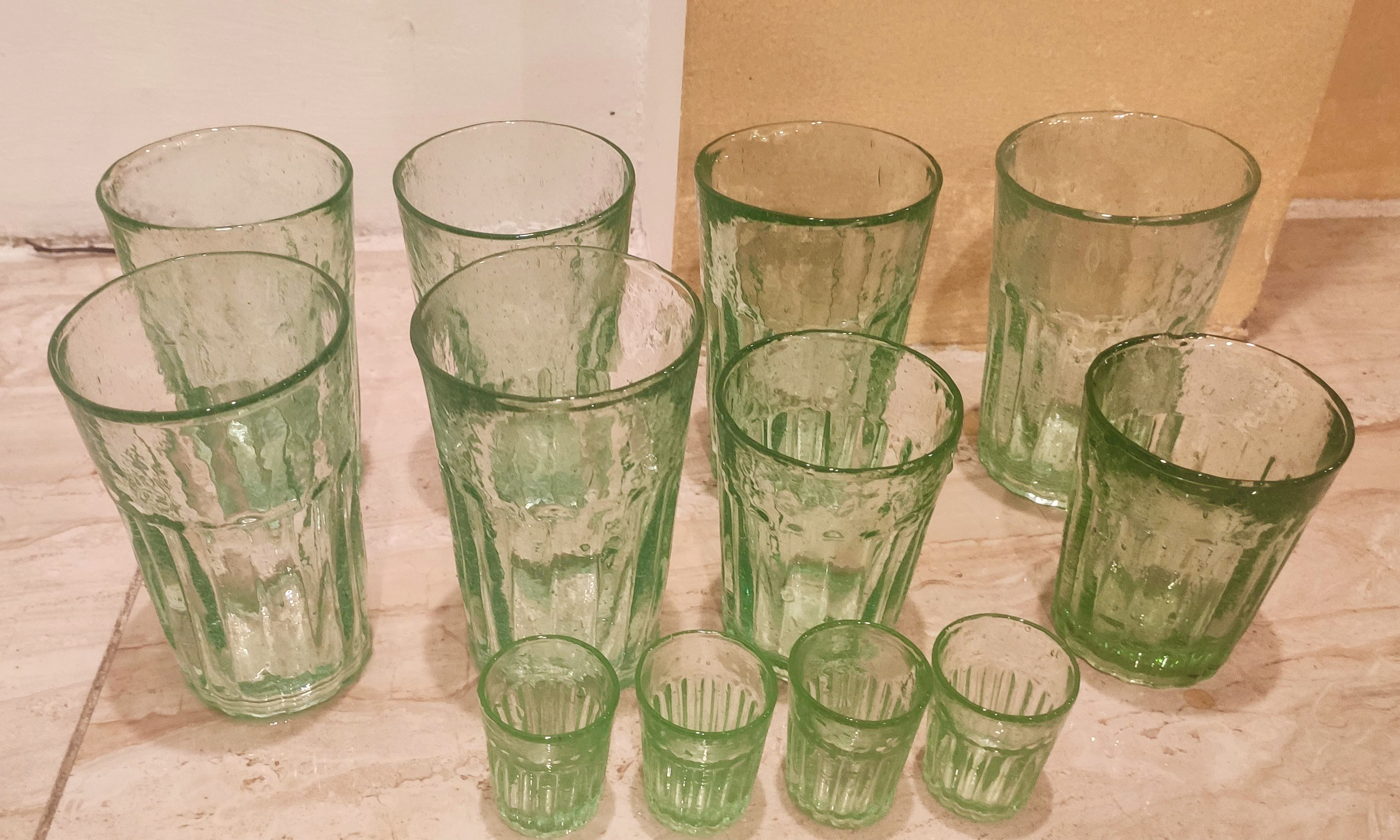
AT first glance, the Bia hơi served in the Ba Dinh Sports Center is the same light draft lager served in every shop on every street in Vietnam’s capital, Hanoi. Like everywhere else in the city, the beer comes from a state-owned company that has brewed it fresh daily since the ’60s and it is served in the same handmade, sturdy, blue-green glass cup–the Bia hơi cốc. But regulars at the sports center will tell you that the beer here is better, fresher, and unlike anywhere else in this city of nearly 9 million people.
An angular Nguyễn Văn Long—in his 70’s, wispy white goatee, matching moustache, puffing out thick plumes of local cigar smoke—explained why. It’s because the beer is “blood-cut” he said in Vietnamese, gesturing to his cốc as he raised it one humid June afternoon. Bia hơi (pronounced “bee-ah hoy” and meaning “fresh beer”) is brewed without preservatives or added carbonation. The kegs in which it is stored aren’t pressurized, which means the beer has to be consumed within 24 hours of leaving the brewery. The finest Bia hơi, blood cut, is the kind tapped and poured as soon as it is brewed. The Ba Đình Sports Center has always gotten exactly that.
This privilege harkens back to the subsidy era, the decade-long state nationalization period Vietnam entered following the defeat of American troops and fall of Saigon in 1975. It ended officially in 1986, with the Đổi Mới (“Renovation”) reforms that nudged Vietnam toward a market economy. But in some corners of Hanoi, government officials still have exclusive access to special shops selling goods at subsidized rates. Although the sports center refreshment shop is now open to all, most regulars are retired senior officials, like Long and the friends he sat surrounded by.
Despite supposedly being a cut above the rest, the beer at the center is still served in a humble cốc (pronounced “coke,” with quick upward inflection). When a drinker tips up the glass to retrieve the last drops of Bia hơi, a capital H, for HABECO, the Hanoi Beer Alcohol and Beverage Joint Stock Corporation, is revealed pressed into the base. It’s the tumbler’s only constant; each cốc is otherwise different.
That tension between sameness and difference, held in the cốc, runs beyond the table. Much is shifting in Vietnam. Fifty years after the fall of Saigon, the country remains a symbol of resistance and self-reliance. But it’s no longer a war-ravaged nation struggling to get back on its feet. Today, it’s one of Southeast Asia’s fastest-growing economies, a rising manufacturing power, often an alternative to China, a curious hybrid of communism and capitalism (officially “socialist-oriented market economy”) and significant enough for Donald Trump to slap a 46% tariff on its goods. Vietnam is on pace to host 25 million tourists in 2026, most commonly from China, though European visits are up 53% year-over-year.
Amid these waves of profound transformation, the Bia hơi cốc has remained unchanged. Cheap and easy to acquire, the glasses continue to be made by hand with recycled glass in small village factories near Hanoi. Conceived in the midst of socialist austerity, it has persisted in the face of imported glassware, shifting design trends, changing tastes, economic reforms, and globalisation. China’s mass-produced crystal products now flood the Vietnamese market. But, no manufacturer, at home or abroad, has yet successfully replicated or replaced the low-priced, unprofitable, “unpretty,” cốc.
So how has the cốc, a slow-to-make, simple in function and form, everyday object, defied the global design logic of perfection and endured for over fifty years?
Some say it is because the cốc is simple: easy to make, easy to buy, easy to use. Others say it is because it is profound, more than a drinking glass, a vestige of an earlier Vietnam. Both seem to hold. What is clear is that the cốc complicates the idea of progress that has reshaped the modern world, and Vietnam, over the past five decades. Neither upgraded nor replaced, neither standardised nor scaled, its persistence points to how the unassuming forces of habit and utility can hold ground against betterment and efficiency.
Understanding how the cốc survived requires looking beyond the glass itself, into the world that created it and the use that drives it.

BEER came to Vietnam with the French, and colonialism.
Hommel brewery, the first in Hanoi, was established in 1890. Making beer was expensive, so supply was low and prices high: the drink was reserved mostly for colonial officials. Due to a shortage of materials like glass and metal there were no bottles or containers and the beer was instead kept in reusable kegs. That era ended in 1954, when the sandal-wearing, bicycle-riding Việt Minh “peasant army,” defeated the French at the Battle of Điện Biên Phủ. North Vietnam became the Democratic Republic of Vietnam and Hommel Brewery became the official state brewery of Hanoi. This was where Bia hơi was eventually born. It took two more decades, and the ousting of yet another Goliath, the United States, for North and South Vietnam to be reunited under communist rule in 1976. As part of its postcolonial nation-building efforts, the new government decided that beer should be made widely accessible as a small but meaningful boost to public morale in the subsidy era. The answer was Bia hơi.
But serving it proved complicated. Beer was available at the government-run beer stations and everyone in a queue was allotted a ticket for purchase. It was being served fresh, so bottles were impractical. Most people brought their own cups, making standardised portions impossible.
Then the Vietnamese Central Cooperative Union of Handicrafts and Crafts, CCUHC, came up with a solution: a standard-sized glass designed specifically for a single serving of Bia hơi. One ticket equaled a single cốc of beer. Across Hanoi, beer was no longer measured by the keg, the server, or the buyer’s wares, but by the cốc. To order a beer was to receive a cốc.
This holds true still even though the queues and ration tickets of the subsidy era have disappeared. But not at the Ba Đình sports center. Here at the refreshment area, a version of the old ticketing system still operates between 4 and 6 p.m., during which beer is served.
Just a 30-minute walk from the HABECO office, where the beer is produced, the sports center long received the earliest kegs of Bia hơi, thanks to its subsidy-era exclusive status. The tradition, Long and his friends insist, holds true even now. So a beer here is not only the freshest in the city, it is among the cheapest, at 5,000 VND or about 20 cents. And that is why, though they live in Hanoi’s Old Quarter–Phố cổ Hà Nội–where most tourists head to for their evening tipple, Long and his friends make their way to Ba Đình instead.
They don’t bother with other beers. “Bia hơi is special,” they announced, ticking off its virtues: Its aforementioned affordability (“one of the cheapest beers in the world”), light enough at 3% ABV to spare you the headache or sluggishness the next morning (“which means you can drink every day”), and refreshing (“a good end to a hot day”). But above all, it is very Hanoi, much like them, Long said proudly. Community is a big part of drinking and drinking Bia hơi is no fun alone.
This was why they come to the sports center every day. Years of showing up meant they knew the ins and outs of this place–what food was good on the menu, who to nod to for service, how to make a fresh jug of beer appear without anyone ever asking. So no staff members batted an eye when they pulled out a bottle of home-brewed, dark-colored, sim fruit-infused rice liquor with a heady smell.
“Typically, you wouldn’t drink sim liquor from this,” Long said, indicating the cốc. Now the beer was gone, but the glass remained.
But why not drink other things from the glass, if it is ever present?
Answer: This is a Bia hơi cốc. It’s meant for Bia hơi.
“The cốc is the beer,” Long explained. “The beer the cốc.”
Hours later, after some cajoling, the octogenarian regulars agreed to do a popular drinking chant they had earlier waved off as childish. Voices tumbled over one another:
Anh em ơiiii, vực nào sâu thăm thẳm?
—“Brothers, what abyss is deep?”
Vực nào sâu bằng cái ly này!
—“What abyss is deeper than this glass?”
Hò zô ta nào!
—“Haul it up!”
Kéo cái ly này lên!
—“Lift this glass high!”
EVERY single Bia hơi cốc in Hanoi is handmade by local glass blowers in the village of Xôi Trì (pronounced “soy chee”), about an hour’s car ride from the city, traffic gods willing. Despite this nearness, the scene and air here are a world apart from the capital. Right next to the highway are rice fields–unending stretches of delicate green, spindly stalks standing in water in the summer heat. The air is thick with their moist, hot, earthy scent.
Xôi Trì sits in Nam Dinh province, in the Red River Delta. Like most villages in the area, it depends on rice cultivation, but glassblowing has long endured as a parallel craft. In the 1980s and ’90s, nearly 85% of the villagers worked in glass workshops. They made everything–light bulbs, bottles, medicine tubes, all kinds of general glassware. But the rise of cheap, mass-produced glass from China wiped out the market for almost everything. Everything except the cốc. Today, only three families in the village still run glassblowing workshops, and all three make just one thing—the blistered blue-green Bia hơi cốc.
Glassblowing is a family trade, said Phạm Ngọc Hinh, the self-described head of one of those families. His grandfather taught his father, his father taught him. Legend has it that grandpa Hình learned the trade as a worker at a Chinese glassblowing facility. Wary of revealing their trade secrets, his employers let him work only a single shift. But Hinh’s grandfather was a tough cookie, “he would hang around after work hours, climb over a wall to secretly watch every step, every day,” Hình cackled. Not only did he manage to master the craft in this manner, he also passed down a livelihood that would span generations. Hình started blowing glass at 16. He is now in his 70s.
Did he ever think of doing anything else? “Never,” he clicked his tongue. He didn’t need to; he loved the craft too much.
His workshop was empty due to rice season–most glassblowers were in the fields, which provided their main source of income. With its pits and crevices and thick layer of dark soot, the roughly 800-square-foot open space workshop resembled an excavation site. Hinh pointed here and there, eagerly indicating where the boiler to melt glass stood, where the glass was blown, where newly formed cups were leveled, and where finished glasses, still hot from the furnace, were buried in ash pits to cool down.
Cooling was essential, he said casually, because every element of the making is hot. “Especially the boiler,” he pointed to a newly crafted giant barrel with its mouth agape like a fish. It took roughly a week to construct, he said, patting it proudly. Once set up, temperatures inside reached 1,800 degrees Celsius. The heat is necessary, he insisted, his eyes twinkling as he compared melting glass to cooking spinach. “You put in a lot and then the heat boils it all down to nothing.”
Of the four daily shifts at the workshop, six hours were spent liquefying glass at the highest possible temperature. Coal was the only fuel that burned hot enough—not wood, not gas. Once lit, work continued until the boiler finally broke down under the strain.
How long does that take?
“As long as it has to,” Hình said in a tone that suggested he’d used that line many times before.
A middle-aged man in trousers and a button-up shirt walked in. They spoke briefly before Hình turned around excited–one of the other workshops in the village was running.
Minutes away, the scooter ride to the workshop felt like wading through a hot sludge of moisture. The Red River Delta, where Xôi Trì sits, is prone to the “wet-bulb effect”—an exhausting combination of heat and humidity. A wet-bulb temperature of just 88 degrees Fahrenheit can prove fatal in a few hours for even a healthy adult, in shade, with unlimited water. It was into the 90s.
Unlike Hinh’s workshop, which is an extension of his home, this one was all business. Piles of glass shards lay stacked in the middle of the courtyard. A woman in a nón lá, Vietnam’s traditional bamboo hat, sat under the sun, sifting through them with a large sieve. Behind her, a covered shed held bundles of glasses packed in white plastic bags. In front, on a raised ground, stood the factory floor.
THE fire in the belly of the boiler surged, dense, orange, wobbling like an ancient, angry egg yolk. A second fire raged in a smaller furnace nearby. Heaps of scorched hay lay around, with freshly blown glasses buried in them.
The choreography on the work floor was hypnotic. Seven workers moved in seamless coordination, their flow so smooth it was difficult to tell where the dance began. Everything revolved around the boiler. Pipes were plunged into it, glowing orbs lifted and blown into shape, jelly-like forms pressed into molds dug into the floor; every time the pipes were pulled out from the molds, a cốc appeared. Its color orange, still, the glass then rested briefly on a leveller and its mouth gently opened before it was hooked, stacked, and carried to the ash pit. One step, two step, a three and a four, and swirl. On and on this circle went, powered by inertia and muscle memory, and not a word was exchanged.
It was far from silent, though. Aside from the bubbling of the furnaces and the whirring of tiny machines, there were the fans. Like giant sentries, they stood around the work floor. Their blast of air didn’t cool so much as stir the heavy, narcotic heat, scattering it like ink through water. As the glass blowers walked past the fans, they dried the sweat patches blooming on shirts and bandanas and generated a constant hum lulling the shop floor into a trance-like state.
All the while, workers fed recycled glass, from factories and recycling facilities, into the boiler. For every three parts of white glass used, there was half a part of green from beer bottles, Hình explained. This mix was what gave the bia hơi cốc its distinctive blue-green tint.
As the sun softened, the shift neared its end. The workers had been at it for six hours. Soon the melter would take over, working alone through the night, tending the fire until dawn. By mid-morning, the dance would begin again.
Did the workers take breaks?
“Yes. But barely,” Hinh said.
How did they deal with the heat?
“Not well. Now that it was getting hotter, what was already hard was getting harder still.”
It was also getting harder to find people willing to blow glass. Most preferred the fields, where the rewards were better. But the heat was making that difficult too.
Hình had once hoped his children, and theirs, would carry on with the trade. But neither generation wanted to step inside the workshop, not with the heat. He didn’t blame them.
Things could change soon. His workshop was waiting for its first mechanical blowers to arrive. At the moment each workshop produced roughly 1,500 cốcs a day. The machine could notch up the numbers by a significant number.
Wouldn’t that change everything?
No, Hình shook his head. It would change nothing, just make one step among many a little easier. If only the workshops could find investors willing to put in money, more machines could be brought in, facilities improved.
But wasn’t the Bia hoi cốc special because it was handmade, at every stage? Weren’t the imperfections this produced part of essence? Machines would alter all of that.
Hình laughed. It was time to go. A cốc makes for a lovely gift; he’d pack some up.
“You know” he said, turning back on his way to pack up the glasses, “at the workshop, the body is also a machine.”


EVERY few weeks, HABECO trucks pull up to the Xôi Trì workshops to collect hundreds of beer glasses, packed by the dozen in straw and bundled into tightly wrapped plastic gunny bags. The embossed H at the base of each cốc is more than branding, it marks the glass’s enduring tether to the company. HABECO remains the workshop’s primary client, sustaining a relationship that has tied the city’s beer culture to its small-scale manufacturers for decades.
The beer glasses circulate through the same networks that distribute Bia hơi itself. As part of its market expansion strategy, HABECO provides new retailers a range of equipment as support, including the cốc. Vendors can order more glasses through the company. Despite their sturdiness, businesses burn through the glasses quickly.
This easy movement through the network obscures the cốc’s workshop origins and the details of its past. The cốc began as an answer to a problem. The man who solved it now sits in his old Hanoi home, surrounded by vestiges of a life spent making art, books, design blueprints, and models.

At 82, bespectacled, his white hair neatly side-parted, designer Le Huy Van, former rector of the Hanoi University of Industrial Fine Arts, gives off an air of unstudied calm. In 1970, when he returned to Hanoi from East Germany as an industrial design graduate, North Vietnam was deep in its war with the United States. East Germany, which viewed the conflict as an anti-imperialist struggle, had stepped in with support and Vân was called in as a translator for German advisors.
Six years later, fresh into his first job as a designer in his own country, he would go on to create the Bia hơi cốc.
Vân’s approach was straightforward. In the spirit of the Werkbund movement and Bauhaus school, both inspirations, function came first. But affordability was key; Vietnam was in a state of economic crisis. “I wanted to make something mundane, unprecious, cheap,” he said in German, still fluent, while making tea in his home kitchen last summer. It had taken just a few days to sketch a plan and produce a prototype. To keep costs minimal, Vân had tapped into the local glass-blowing community outside Hànoi developing a handblown vessel made of recycled glass.
The utilitarianism drew on a lineage of everyday objects from early independent North Vietnam. Among the most iconic among these were the dép lốp, or “tire sandals,” fashioned from discarded French military tires and used during the war against the French. Simple, durable, lightweight, and made from recycled material, American soldiers called them the “Ho Chi Sandals,” after their most famous wearer, nationalist leader Ho Chi Minh. Equally emblematic were the Thống Nhất bicycles, produced by a state-owned factory established in 1960 and distributed as essential goods during the subsidy era, when private vehicle ownership was limited.
Time, however, has transformed these objects in ways it hasn’t touched the Bia hơi cốc. The sandals have become collectible memorabilia, with only a few makers left in Hanoi. Thống Nhất was privatized in 2017, its designs modernized and production mechanized. All these shifts were in keeping with Vietnam’s broader move toward an open economy following the Đổi Mới reforms.

Vân’s work has evolved alongside the country’s transformation. In 1996, soon after the US lifted its trade embargo and Coca-Cola officially returned to Vietnam, he sent in a winning entry for a redesigned Coke bottle. In the early 2000’s, as Vietnam entered a period of mass motorbike ownership, he also designed the Sufat motorbike, among the first domestically manufactured motorcycles in the country.
As Vietnam’s beer culture expanded and diversified, Vân’s glass moved with it.
The cốc’s charm has long spilled past the radius of registered Bia hoi retailers in Hanoi. Among those who have taken it up are Hanoi’s craft beer bars, like Turtle Lake Brewing Co. Founded in 2017 by former U.S. resident Lamont Wynn and perched on the upscale edge of Tay Hồ, Hanoi’s largest lake, the brewpub hosts some of the country’s largest breweries at its annual festival. Here Wynn often serves beer in the Bia hơi cốc.
The choice is practical, he said. The glass is cheap, sturdy, easy to source, and links the brewpub to Hanoi’s older drinking culture. But it comes with its own peculiarities, chief among them the difficulty of branding it. Wynn never found a satisfactory way to brand the cốc’s uneven body and turn it into merchandise.
Turns out, try as you might, the Bia hơi cốc remains the Bia hơi cốc.
Lamont Wynn, founder of Turtle Lake Brewing Co.
Others have encountered similar limitations. Before starting Baï Sim Glasses, French designer Kevin Levon worked with an international brand where he once proposed selling Hanoi’s beer tumbler abroad. “I love the cốc,” he said, “and wanted more people, especially outside Hanoi and Vietnam, to experience it and for the craftspeople behind it to benefit.” But the idea never took off. The cốc’s irregular thickness, slight variations in size, tint, and bubble patterns, i.e. the very qualities that make it unique, made it seemingly misaligned with conventional market standards.
In other contexts though, those same limitations have proved advantages. For one, they kept the cốc from being copied by large manufacturers. The design is not patented, so replicas would be legal. But reproducing irregularity at scale is expensive. A glass with a small, local market and a low price offers little incentive. What manufacturer would bother?
Designers like Levon, on the other hand, have turned to the cốc precisely for its imperfections. Working with Xôi Trì artisans, he developed the Baï Sim Glasses as a tribute to the original. Thicker and more uniform, these are still marked by small variations from hand production and now sold commercially and exported. The cốc’s irregularity is also foregrounded by Common Display, a Berlin-based platform focused on everyday objects, which includes it in its limited pre-order €36 “Hanoi Capsule Collection,” highlighting recycled glass and “visible imperfections.”
Such interventions matter because they shift the glass from a fragile local economy, where its value lies in being cheap, into a broader one, where its distinctive qualities become an asset. When production is tied to low-paid manufacturing in constrained settings, even skilled craft practices can stagnate. External collaborations can provide a much-needed shakeup.
Still, a tension remains. The Bia hơi cốc was born to support everyday drinking and working-class sociability. It belonged to a system that valued participation over ownership. The glass was cheap by design, its affordability was political–anyone could drink from it. Once removed from this setting, that logic begins to thin. Detached from the gestures and routines that give it meaning, the cốc risks becoming an object to be displayed, discussed, collected. A commodity rather than a practice.
The cốc no longer belongs to me. It belongs to the people.
Le Huy Van, creator of the Bia hơi cốc
For all this reworking of the cốc, Le Huy Van remains untroubled. Technology, and its potential impact on the glass he once created, doesn’t faze him. The cốc, he pointed out, was made with the technology available in Vietnam at the time of its making. It briefly held half a liter of beer before being scaled down to the present 0.33 liters, but beyond that, its design hasn’t changed in over five decades. Despite modern advances, Vân never considered “improving” it. There was no reason, the cốc turned out exactly as he intended.
“Although,” he said with a hint of a smile and switching to Vietnamese, “people initially wanted the glass to be clear.”
But he never felt the need to make that change.
“Why would I? The cốc no longer belongs to me,” he said with a shrug. “It belongs to the people.”
And like much that belongs to the people, the cốc is subject to forces beyond it.
In 2019, Vietnam passed the Law on Prevention and Control of Alcohol-related Harm. In 2025, the National Assembly approved a plan to raise alcohol taxes to 70 percent by 2027 and 90 percent by 2031. The tax hikes follow rising concerns within the ruling party about excessive drinking in Vietnam, which is Southeast Asia’s second largest beer market after Thailand. Alcohol is also the second highest cause of death in Vietnam and consumption rates have skyrocketed, from 2.9 liters/person in 2005 to 7.9 liters in 2019.
For Bia hơi—an ultra-low-cost, high-volume product—the effects of these measures may be sharp. If and when the price of Bia hơi rises, the volumes consumed will likely fall. The pressure of this shift will extend to the objects tied to it. Fewer sales mean fewer glasses in circulation, fewer replacements, and less demand for their production.
Beyond these systems of production and policy though there are other measures of time. In Vân’s home, busy with his art, his students, and his many art experiments, there is a quiet sense of it running out.
At the center of the seating area in the living room one evening stood four lotus stalks, their petals long fallen and resting in a crisp circle at the base of the stems. The flowers had come from the Tây Hồ lake, Vân said. Scrolling through his phone he showed how he’d documented each stage of their withering on social media. “What stage are you in?” he’d captioned the photos.
What stage did he think the Bia hơi cốc was in?
“The middle stage,” he said, smiling. “Unlike me.”
Would they survive?
He paused. “I hope so,” he said at last.

THE breeze from the Tây Hồ barely holds through the walk to the Ba Đình Sports Center. Still, there is reason to endure the shirt-soaking heat, because timing matters. The sports center fills up fast on weekdays, and you’re liable to miss the two-hour window in which it serves Bia hơi.
First come the queues, then the payment, then the small paper tokens exchanged for blood sausages, boiled peanuts, fried tofu, and large white plastic jugs of Bia hơi. Amid the lingering traces of older systems, nostalgia takes root easily. Elderly men in shorts sit in mono bloc chairs set around square tables. Jugs, glasses, food, cigarettes, and playing cards are all set up with the quiet ceremony of habit and in anticipation of company. The steady pop of tennis balls outside and the drone of the overhead fans drown out the murmur of the gathering crowd.
On that June afternoon, the regulars were all in attendance. Their days here are full, with swimming, salsa, and tennis. Then in the evening there is always beer. The progression made sense; in Hanoi, sports and Bia hơi often go together, one regular, Pham Hồng Thái, said.
He sat at Long’s table, a small banquet of Tupperware containers spread before them, holding noodles, fish, crackers, sausages, papaya salad, and a careful little pouch of salt, all packed and brought from home. Excitedly, the men described how to eat the treats on the table as tiny dogs on leashes trotted by. Later in the evening, as the beer loosened people up, feet would swing onto chairs and shirts would be rolled up to chests.
Just a few meters away, a sign detailed everything patrons were forbidden to do in the refreshment area–bring in outside food, stoves, or animals, start fights, go shirtless, or put their feet on the tables. But notices didn’t deter the regulars, veterans of the place for decades. Rules here weren’t enforced or broken so much as sidestepped, like wayward puddles.
Here the uncertainties around Bia hơi and the cốc felt distant, barely real. Clinking quietly on every table, the cốc hid in plain sight. Being commonplace is its camouflage.
As the evening darkened, rain fell against the awnings and the lights dimmed, someone came by to tell Long and his friends that the last orders had been served. The noodles and cigars were finished, the jugs of Bia hơi now all empty. As the men pushed back their chairs and dawdled to the gate, they cracked a parting joke and waved goodbye to the other regulars still packing up.
The cốcs stayed huddled together in one corner of each table, waiting to be rinsed of all the evening’s rituals. Waiting for the next day.

Parni Ray
Parni (she/her) is a writer, design researcher and policy analyst living between Chiang Mai and Kolkata. Her work has appeared in The Caravan, WIRED, Indian Quarterly, Architectural Digest and elsewhere. When not writing she is usually sitting, sighing next to a pile of things she meant to read.
This story was made possible by the support of Sunday Long Read subscribers and publishing partner Ruth Ann Harnisch. Translation work by Hiếu Trung Nguyễn. Photos/videos by Parni Ray. Edited by Peter Bailey-Wells. Designed by Anagha Srikanth.
Leave a Reply
You must be logged in to post a comment.